Sub-MW Wind Turbines: Drivetrain Monitoring Without a CMS
A gearbox replacement on a 600 kW turbine costs a large share of a 2 MW repair, on a fraction of the revenue. Battery-wireless vibration monitoring finally makes CMS viab…
Read article →

delivering real data
Wireless condition & structural health monitoring
enervisual sensors capture raw time waveforms and order-based spectra from wind turbines and industrial machinery, and send them over long-range wireless to a platform that already knows your drivetrain. You install the sensor and pick the turbine type. Monitoring starts the same day.
Designed and manufactured in the EUDanish company
Why enervisual
Wired systems give analyst-grade data, but they bring cabling, cabinets and mains power, so only the most critical machines get them. Simple wireless pucks are cheap to fit, but they report an overall RMS value. That tells you something changed, not what changed.
enervisual removes that trade-off. You get the full signal, sent wirelessly, from a battery that lasts years. The gearbox in a remote turbine, the foundation under it, and the pumps and fans in your plant can all be monitored properly.
Solutions
Every package includes the full chain: sensor nodes, wireless transmission, a web platform and an API. The price you see is the price of a working system.
New
Software on a site server that connects to the drivetrain vibration CMS already installed on your wind turbines. It reconfigures data capture for low-speed vibration diagnostics on main bearings and planetary stages, and delivers waveforms, spectra and trends with full metadata in one open data format.
Read about the CMS Adapter →Works with
The major drivetrain vibration CMS platforms, including legacy units the vendor no longer supports.
Which CMS is on your turbines? Ask us →Pre-configured spectral libraries for specific wind turbine types: gear mesh, bearing defect frequencies and shaft orders, all validated in advance. Order-based analysis keeps fault trends comparable at any speed.
Your turbine type, ready to go →Continuous tilt, strain and vibration data from the foundation, from battery-wireless nodes that go onto existing structures without cabling or turbine downtime. Use it for lifetime extension, repowering decisions and new-build validation.
Read about the package →Direct measurement of the gap between blade root and blade bearing, across every turbine on your sites. It replaces a full day of stop, lock and inspect work in the hub, and catches the defect before it turns critical.
How it works →SHM sensors for blades, tower and foundation: vibration, inclination, strain, proximity, humidity and temperature. Engineering-grade inputs for stiffness and condition assessment, with low CapEx.
Explore SHM →The same nodes cover gear motors, pumps, fans and agitators in production lines, food and process plants. They suit washdown zones and flexible layouts, where pulling cable is as impractical as it is in a nacelle.
The sensor range →Temperature, humidity, CO₂, particles, sound and leak detection, inside and around your assets or in buildings. High-quality data for operations, research and AI development, through the same open API.
See the range →Technology
Many wireless products sample too slowly, resolve too coarsely and compress the signal until only a trend indicator is left. We built ours for the opposite job.
You get the actual signal, not just processed indicators. When the platform flags a bearing fault, your analyst (or ours) can open the TWF and confirm it. Nothing is hidden inside a proprietary index.
Turbines follow the wind and drives follow production. Normalising to shaft rotation keeps every gear mesh and bearing signature in a fixed place, so trends stay comparable at every speed.
A growing library of spectral configurations per turbine type. You don't need to find tooth counts or bearing designations, and you can't watch the wrong frequency for months by mistake.
The platform tells you which bearing, which stage, how severe and since when. A plain "vibration increased" alert doesn't. Pre-configured component knowledge makes the AI sharper.
Measurements are triggered by operating conditions, so the machine is captured in a defined, comparable state instead of at random moments. This is also why a battery can last up to a decade.
The API works in both directions. It feeds your maintenance systems, historians and dashboards, and it can take in data from monitoring hardware you already own. There is no lock-in either way.
Platform
Battery-powered and IP67. Mounts by stud or magnet in minutes, with no cabling and no downtime.
Low-power LoRaWAN transmission from node to gateway to cloud. It works on remote turbines and on factory floors.
Trends, spectra, waterfalls, TWF download and alarm management in any browser. No installation and no per-seat licences.
Integration APIs deliver the data to your CMMS, historian, SCADA dashboards or your own analytics.
Industries
Onshore and offshore operators, service providers and consultants. Use it as an add-on alongside your existing CMS, or as a complete monitoring package for drivetrain, blades, tower and foundation.
Add-on monitoring →Production lines, drives, pumps and rotating equipment, including hygiene zones and washdown areas where wired systems are impractical.
Read more →Universities and R&D teams use enervisual sensors and the open data API to collect high-quality measurement data for research and AI.
Sensor data for AI →Since 2022 the University of Southern Denmark (SDU) has used enervisual sensors and our data API in its HYG research project. Before choosing us, SDU tested the sensors in a climate chamber at the Danish Technological Institute, where they performed significantly better than competing sensors.
FAQ
enervisual is a Danish technology company that develops battery-powered wireless sensors and a web platform for condition monitoring and structural health monitoring (SHM) of wind turbines and industrial machinery. The enerVib wireless vibration sensor captures analyst-grade data, including raw time waveforms and order-based spectra, and the platform turns it into component-level diagnoses.
In the European Union. enervisual is a Danish company, and our sensors are designed and manufactured in the EU.
Up to 10 years. The sensors do not stream continuously. They measure when the machine is in a defined operating condition, which keeps data comparable and saves energy.
Sampling up to 16 kHz, 20-bit resolution and an ultralow noise floor of 20–27 µg/√Hz. Each measurement includes the raw time waveform (TWF), plus conventional and order-normalised spectra. That is the data a vibration analyst needs to see early bearing and gear faults.
No. enervisual maintains pre-configured spectral libraries for specific wind turbine types, covering gear mesh frequencies, bearing defect frequencies, shaft orders and alarm bands. You install the sensor, select the turbine type, and monitoring starts.
Yes. Many customers use enervisual as an add-on for components or problems their existing CMS does not cover, such as foundations, blade root inserts or extra drivetrain points. The open API works in both directions, so data can flow into your SCADA, CMMS or historian, and existing hardware can feed the platform.
Yes. The enervisual CMS Adapter is software on a site server that connects to the drivetrain vibration CMS already installed (read-only by default), including legacy platforms the vendor no longer supports. It reconfigures data capture for low-speed vibration diagnostics on main bearings and planetary stages, and delivers time waveforms, spectra and trends with full metadata in one open data format, through an API. No new hardware is installed on the turbine. Tell us which CMS your turbines have, and we will tell you what the adapter can get out of it.
Worldwide. The sensors use LoRaWAN, a long-range wireless standard available around the world, and the platform runs in any web browser. Systems can be deployed on wind farms and industrial sites in any country. Tell us where your assets are and we will set up the sensors for your country's radio frequency plan.
Sensors mount by stud or magnet in minutes. No cabling, mains power or turbine downtime is needed. Foundation and structural packages install in hours, not weeks.
Insights
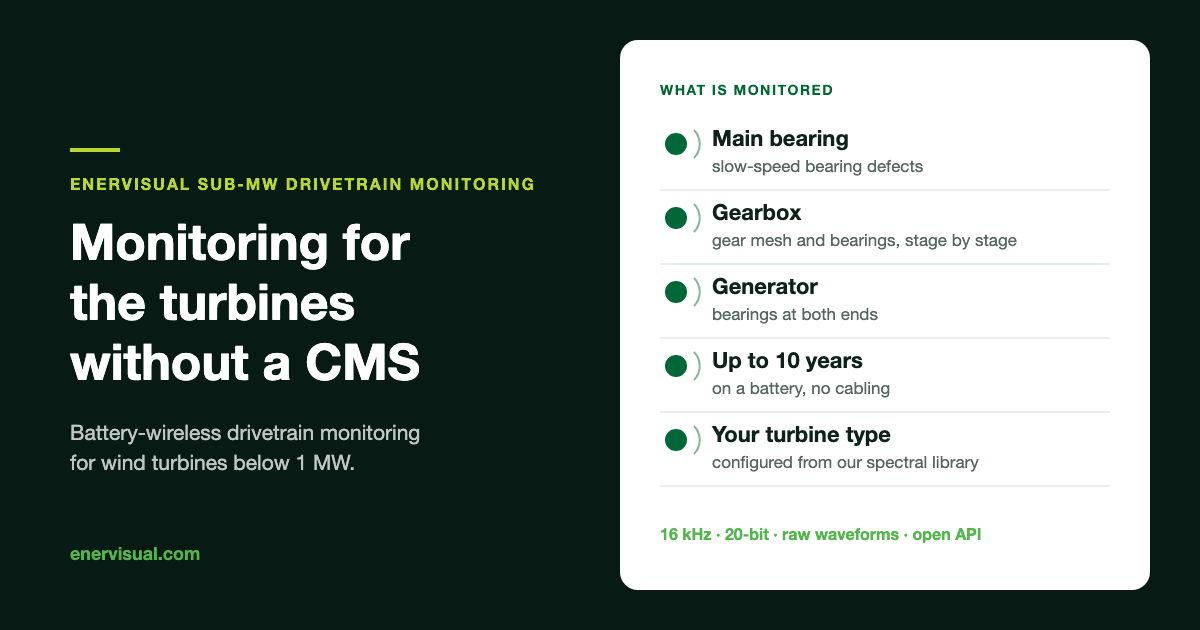
A gearbox replacement on a 600 kW turbine costs a large share of a 2 MW repair, on a fraction of the revenue. Battery-wireless vibration monitoring finally makes CMS viab…
Read article →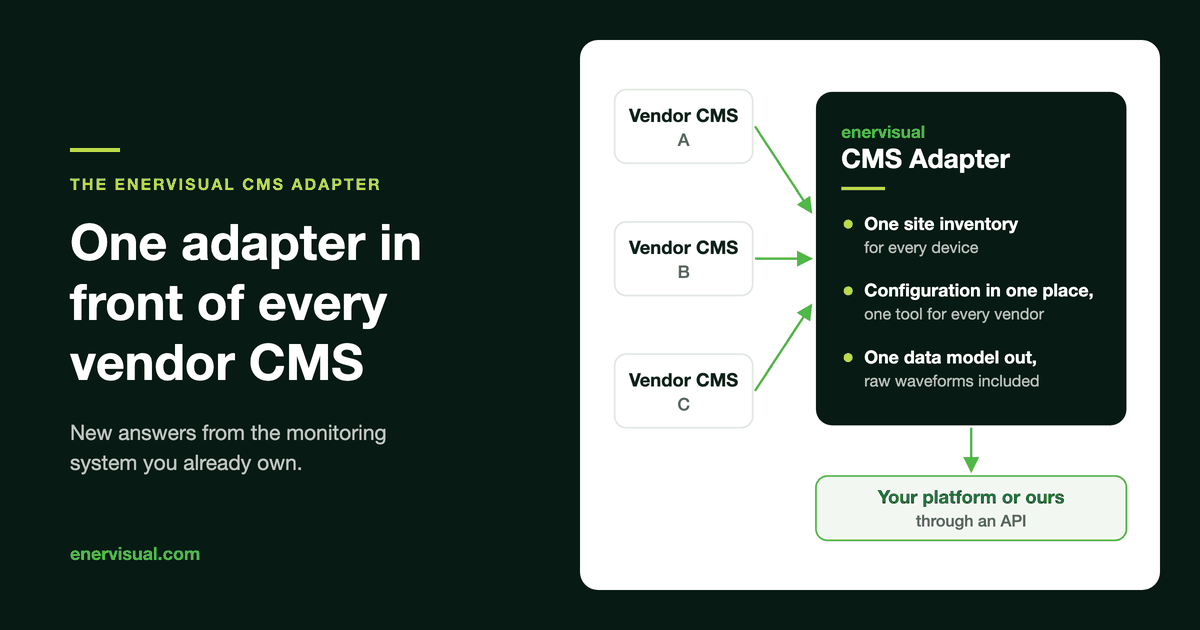
Low-speed vibration diagnostics for main bearings and planetary stages from the CMS already on your wind turbines, including legacy systems. No new hardware.
Read article →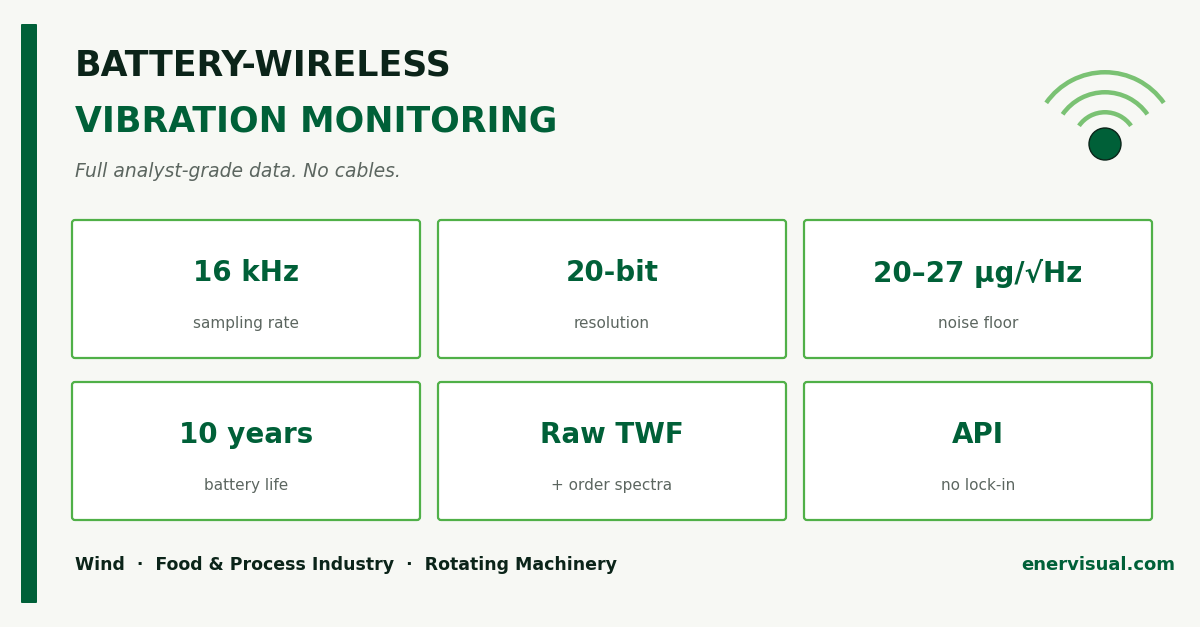
The enervisual sensor range — order-based spectra, raw time waveforms, and a 10-year battery life in one wireless package. For decades, vibration monitoring has forced a…
Read article →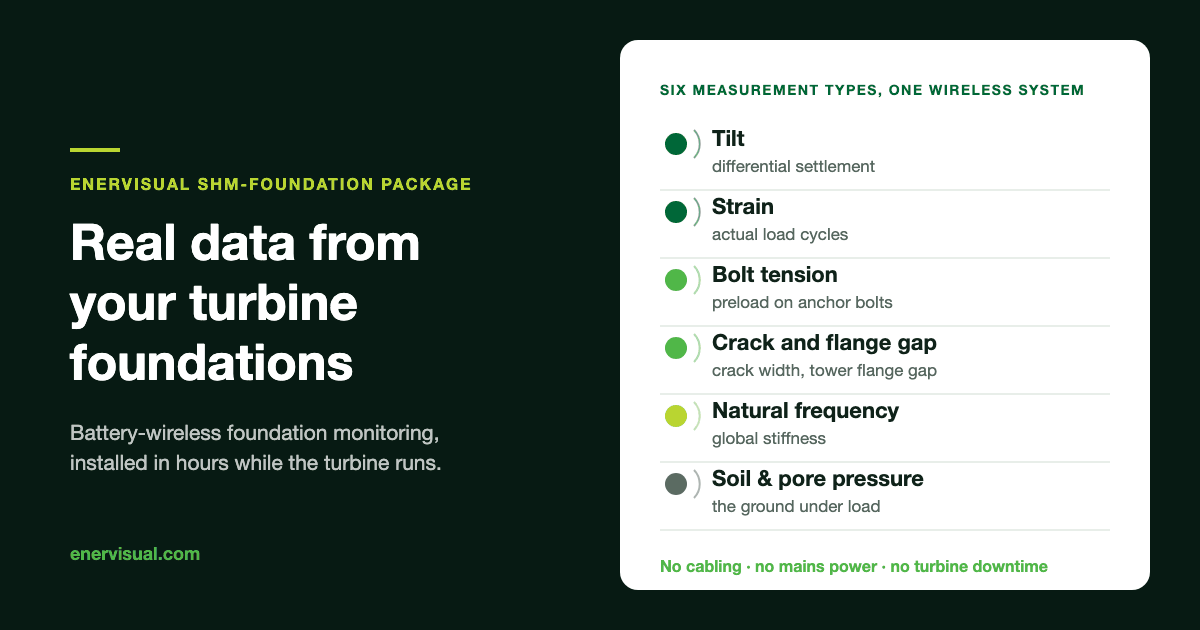 Condition Monitoring
Tell us your turbine types, structures or production assets. We'll show you what continuous data from them would look like and what it would cost to get it.