SHM-Foundation Package

Wind turbine foundation monitoring

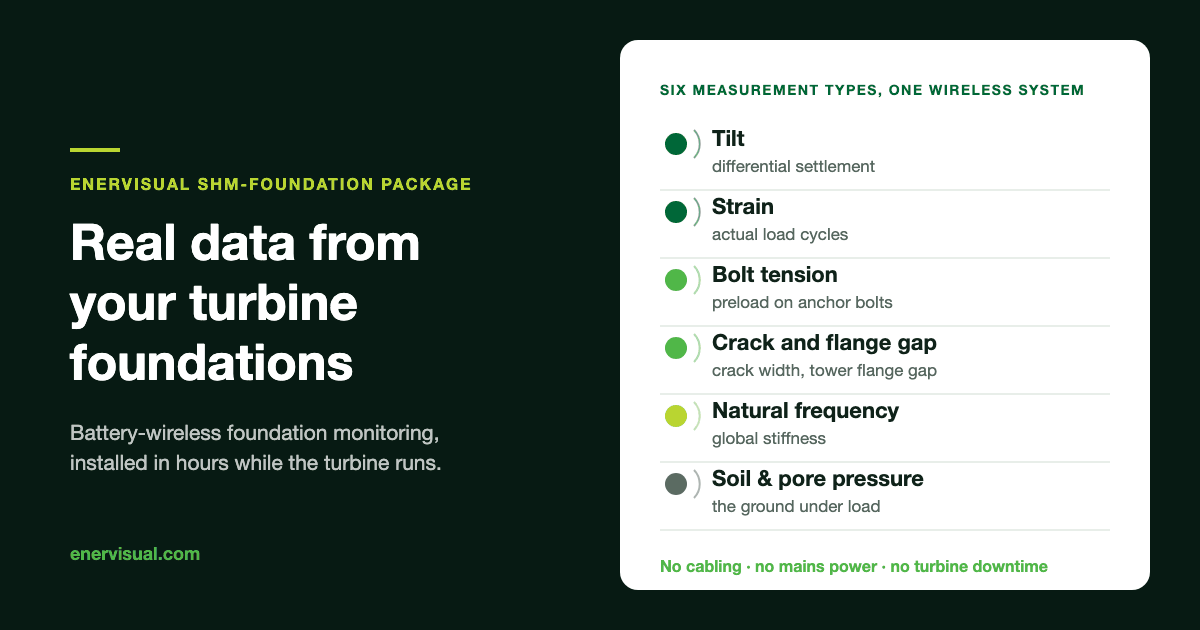
Continuous tilt, strain, bolt tension, crack growth and natural frequency data from your wind turbine foundations. Battery-wireless nodes install in hours on existing structures, with no cabling and no turbine downtime. Measured evidence for lifetime extension, repowering decisions and new-build validation.

6
measurement types, one wireless system
Hours
to install, while the turbine runs
No cabling
no mains power, no core drilling
Years
of battery life

The problem

The least monitored safety-critical part of the turbine

A wind turbine foundation carries overturning moments some 40 times higher than ground-mounted machinery, and its settlement limit is about three times stricter than for buildings: a differential settlement of just 1 mm/m tilts the top of an 80 m tower by 80 mm. Over some 10 million load cycles, the bolted tower connection slowly loses preload.

Yet most foundations get a visual inspection every year or two and a settlement survey every five years, if at all. Conventional SHM systems need a measurement cabinet, mains power and cables through the foundation, and multiplied across a wind farm the business case collapses. The SHM-Foundation Package removes that barrier.

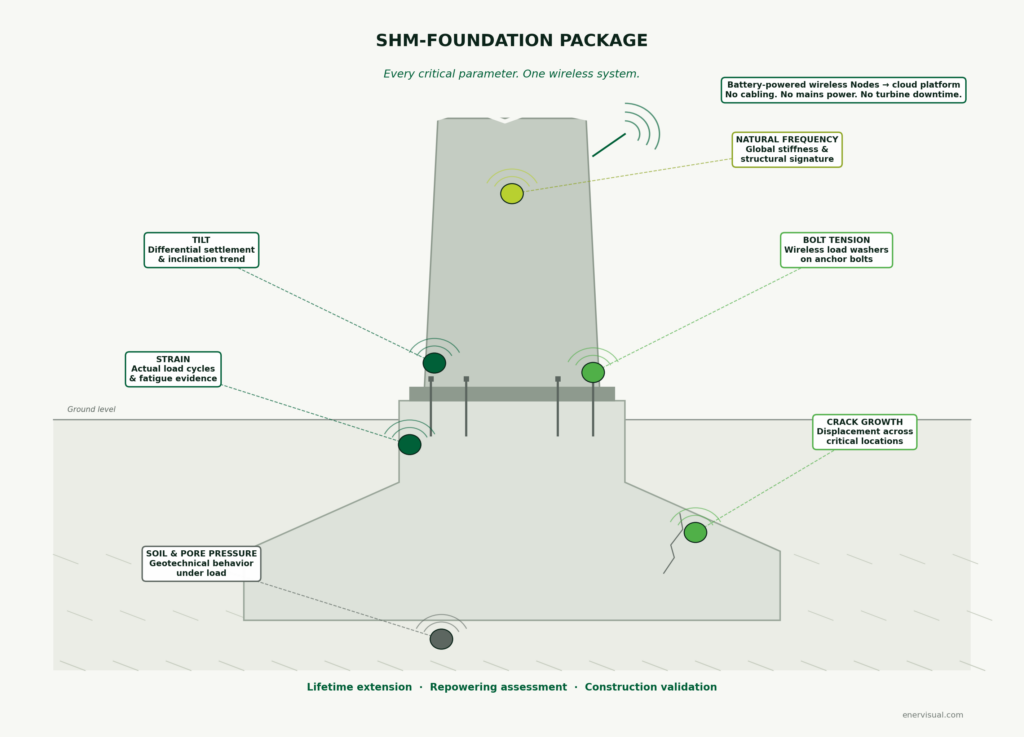
Diagram of a wind turbine foundation and tower base with battery-wireless nodes measuring tilt, strain, bolt tension on the anchor bolts, crack growth in the concrete, natural frequency of the tower and soil and pore pressure under the foundation, all sending data to the cloud platform.
The SHM-Foundation Package: six measurement types from battery-wireless nodes, with the data trended on the enervisual platform.

What it measures

Every critical parameter, one wireless system

01

Tilt

Continuous inclination at the centre of the foundation, the direct indicator of differential settlement. Measured in two axes, so you see the direction too, N-S-E-W or finer. Reveals trends, seasonal variation from freeze-thaw and groundwater, and any acceleration, with resolution well below the 1 mm/m limit.

02

Strain

Strain gauges on the inside wall at the bottom of the tower give the tower bending moment and the actual load cycles, so fatigue assessment is based on measured stress history instead of design load spectra.

03

Bolt tension

Wireless load washers measure the clamping force on the tower-foundation bolts continuously, catching preload loss long before a gap forms.

04

Crack growth and flange gap

Displacement transducers track crack width at critical locations: a stable crack is a documented condition, a growing crack is an early warning. Across the tower flange and the foundation, the same sensor measures the gap at the connection.

05

Natural frequency

Changes in stiffness, from soil consolidation, concrete degradation or a loosening connection, shift the natural frequencies of the foundation-tower system: a global health indicator for the whole structure.

06

Soil and pore pressure

Where the ground is a concern, such as piled-raft foundations in clay or fluctuating groundwater, these sensors document how the soil under the foundation behaves under load.

Example

Bending moment against tilt: the stiffness of your foundation, measured

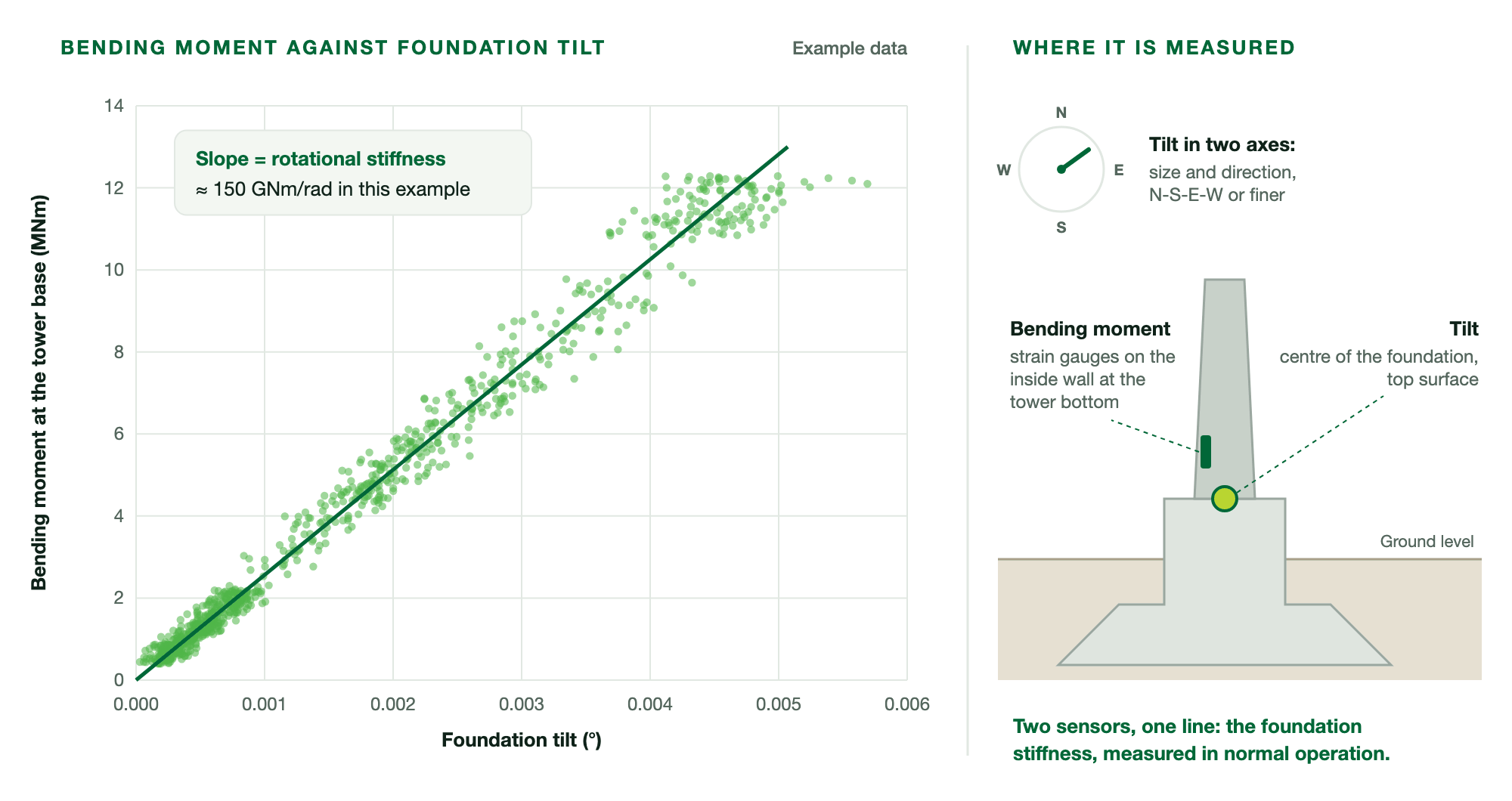
Plot the bending moment at the bottom of the tower against the tilt at the centre of the foundation, and the measurements form a straight line through zero. Its slope, moment per unit of tilt, is the rotational stiffness of the foundation, the property turbine manufacturers set requirements for. Measured in normal operation, not calculated from drawings.

Followed over time, the line shows whether the foundation is changing. A falling stiffness points to soil consolidation, concrete degradation or a loosening connection, long before anything is visible. And because tilt is measured in two axes, you also see in which direction the foundation tilts.


Example data: bending moment at the tower base in MNm plotted against foundation tilt in degrees. The points follow a straight line through zero whose slope is the rotational stiffness, about 150 GNm/rad in this example. A side panel shows the strain gauges on the inside wall at the tower bottom, the two-axis tilt sensor at the centre of the foundation top surface, and a compass for the tilt direction.
Example data. Bending moment from strain gauges at the tower bottom against tilt at the centre of the foundation. The slope of the line, moment per unit of tilt, is the rotational stiffness of the foundation.

Bolt tension

Preload relaxes silently. A torque check is a snapshot, you need a trend

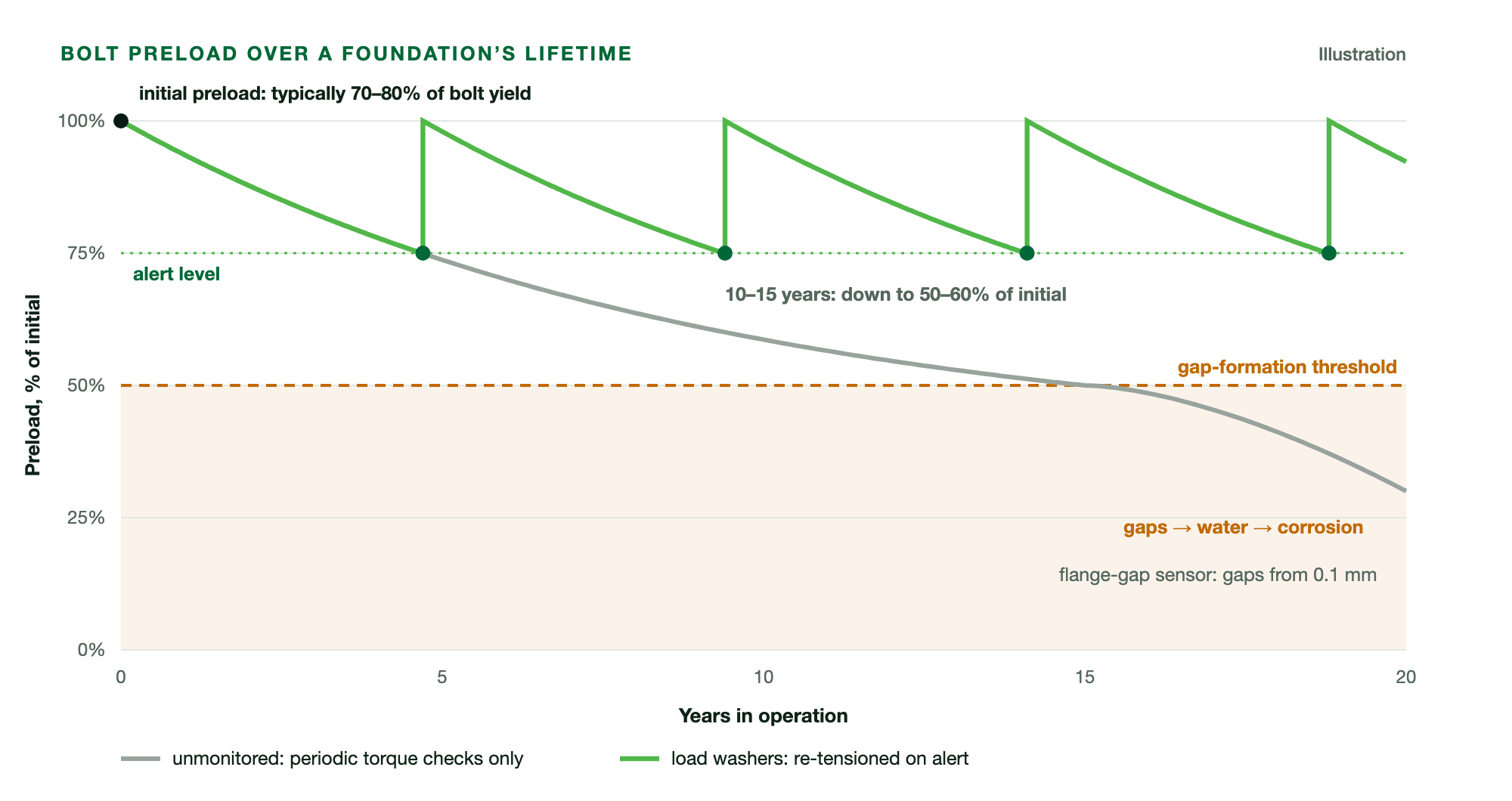
Tower-foundation bolts see millions of load cycles. The initial preload, typically 70–80% of bolt yield, gradually relaxes: after 10–15 years it can drop to 50–60% of the original value. Below a threshold, microscopic gaps form at the connection, water gets in and corrosion starts. What began as invisible relaxation becomes a visible 2–5 mm gap and an emergency repair.

Most foundations still rely on periodic torque checks, a snapshot every few years. Wireless load washers measure the clamping force continuously, and the flange-gap sensor catches gap formation from 0.1 mm, so the bolts are re-tensioned on an alert, long before the repair becomes costly.

Illustration of bolt preload over 20 years. Without monitoring, preload relaxes from its initial value to 50–60% after 10–15 years, crosses the gap-formation threshold and drops further as gaps, water and corrosion take over. With wireless load washers, an alert at a set level triggers re-tensioning, so preload stays well above the threshold.
Illustration. Without monitoring, preload relaxes until gaps form. With load washers, an alert triggers re-tensioning long before that.

Crack and gap sensor

One displacement sensor for concrete cracks and the tower flange gap

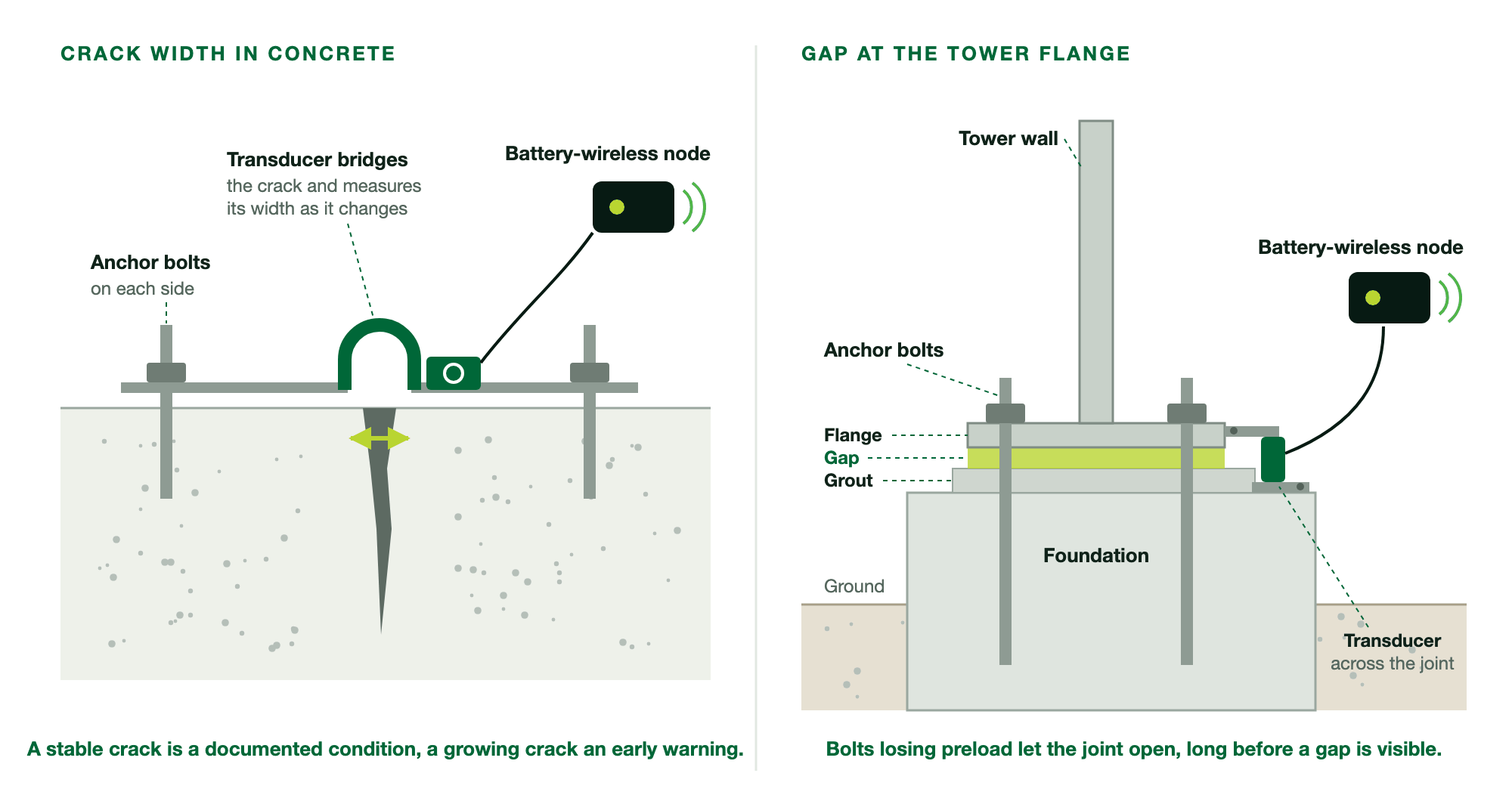
A displacement transducer bridges the crack and is fixed with anchor bolts on each side. As the crack opens or closes, it measures the change in width, continuously and wirelessly. A stable crack becomes a documented condition, a growing crack an early warning.

Fixed across the tower flange and the foundation, the same sensor measures the gap at the connection. When the anchor bolts lose preload, the joint starts to open under load long before a gap is visible, and water can get in. Measured early, it becomes a scheduled repair instead of an emergency.

Left: a displacement transducer fixed with anchor bolts on each side of a concrete crack, bridging the crack and connected to a battery-wireless node. Right: the tower wall and flange on the grout and the foundation, which stands above ground level, with the same transducer fixed across the joint to measure the gap between flange and grout.
Left: a displacement transducer across a concrete crack. Right: the same sensor across the joint between the tower flange and the foundation, measuring the gap as it opens.

Who it is for

Three decisions the data pays for

Lifetime extension

Turbines past their 20-year design life must show that continued operation is safe. Present measured settlement history, crack stability, bolt tension and load cycles instead of conservative assumptions.

Repowering

Can a foundation designed for a 1.5 MW turbine carry a 3 MW replacement? A monitoring period before the decision gives the measured baseline, including the rotational stiffness to compare with what the new turbine requires: reuse the foundations that pass, and avoid an expensive mistake on those that do not.

New wind farms

Monitor the first turbines through construction and early operation to validate the foundation design. If settlements come in below predictions, there may be room to optimise the design for the remaining turbines.

Getting started

From a conversation to data within weeks

  1. 1

    Tell us about the foundation

    Foundation type, age, known concerns and the decisions the data needs to support.

  2. 2

    We configure and install

    A sensor package for your structure, installed in hours on the existing foundation while the turbine keeps running.

  3. 3

    Follow the trends

    Data arrives automatically, trended and correlated with turbine operating data, with alarm thresholds on our platform or through the API.

FAQ

Questions about foundation monitoring

What does the SHM-Foundation Package measure?

Six measurement types: tilt (differential settlement), strain (load cycles), bolt tension on the tower-foundation bolts, crack growth, the natural frequency of the foundation-tower system, and soil and pore pressure where the ground is a concern. All from battery-wireless nodes in one system.

Does installation need cabling or turbine downtime?

No. The nodes mount on the existing structure: no core drilling for cable routes, no cabinet, no mains power and no coordination with the turbine electrical system. A typical foundation installation takes hours, and the turbine keeps running.

Can the data support a lifetime extension?

Yes. Lifetime extension frameworks such as the German BWE guidelines recognise crack monitoring, inclination monitoring and accompanying condition monitoring as assessment methods, and favour permanent measurement over periodic campaigns. Measured data supports longer extension periods with fewer restrictive conditions.

How long should we monitor before a repowering decision?

Even a 12-month monitoring period delivers a measured baseline: settlement, connection integrity and load cycles. That turns a conservative guess into an engineering assessment of whether the foundation can carry the new turbine.

Can you measure the stiffness of the foundation?

Yes. The bending moment from strain gauges at the tower bottom, plotted against the tilt at the centre of the foundation, gives the rotational stiffness of the foundation: moment per unit of tilt, measured in normal operation. Followed over time, it shows whether the foundation is changing.

Can it monitor the gap at the tower flange?

Yes. The displacement transducer used for cracks can be fixed across the joint between the tower flange and the foundation, where it measures the gap as it opens under load. Together with bolt tension, it shows a loosening connection long before a gap is visible.

Do you help us interpret the data?

Yes. Besides the measurements, we offer evaluation of the data for estimating the foundation characteristics, as the basis for the engineering calculations.

How is the data collected?

Automatically. Battery life is measured in years, there are no site visits for data collection, and the platform alerts you when something changes. The data is also available through the API.

Tell us about your foundations

Foundation type, age and known concerns. We will tell you which measurements answer your question, and how soon the data can flow.