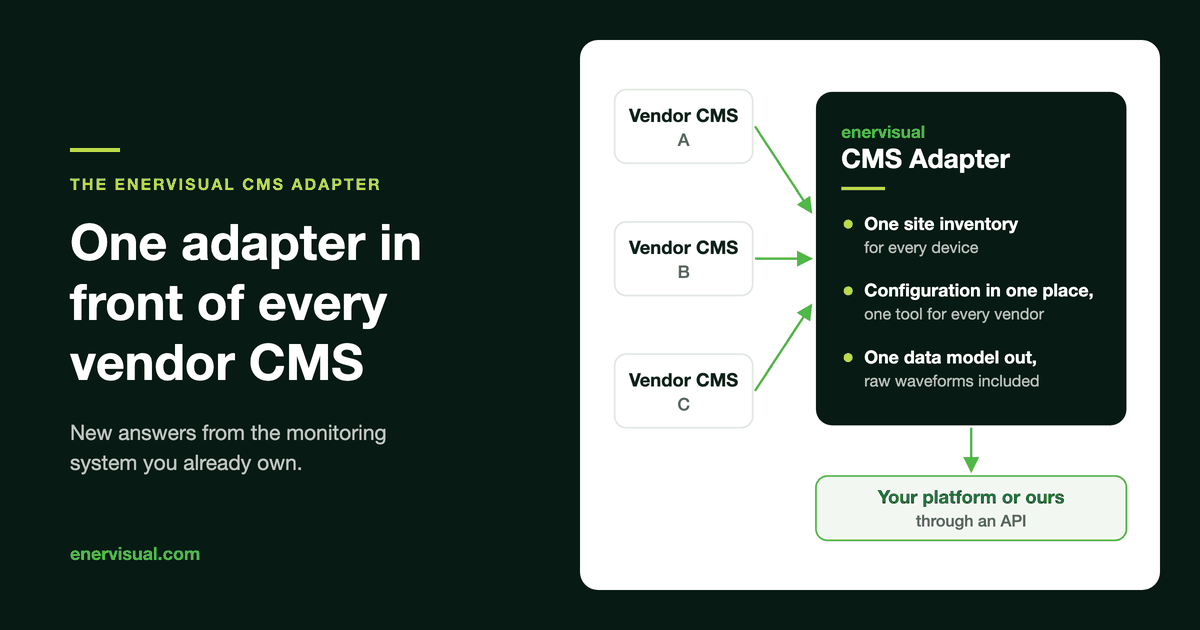
The CMS Adapter: New Answers from the Monitoring System You Already Own
Low-speed vibration diagnostics for main bearings and planetary stages from the CMS already on your wind turbines, including legacy systems. No new hardware.
Read article →

Software for the CMS already installed
One interface for every vibration CMS in a multi-vendor wind fleet. Low-speed main bearing and planetary diagnostics from the hardware already on your turbines, delivered to your platform or ours.
The problem
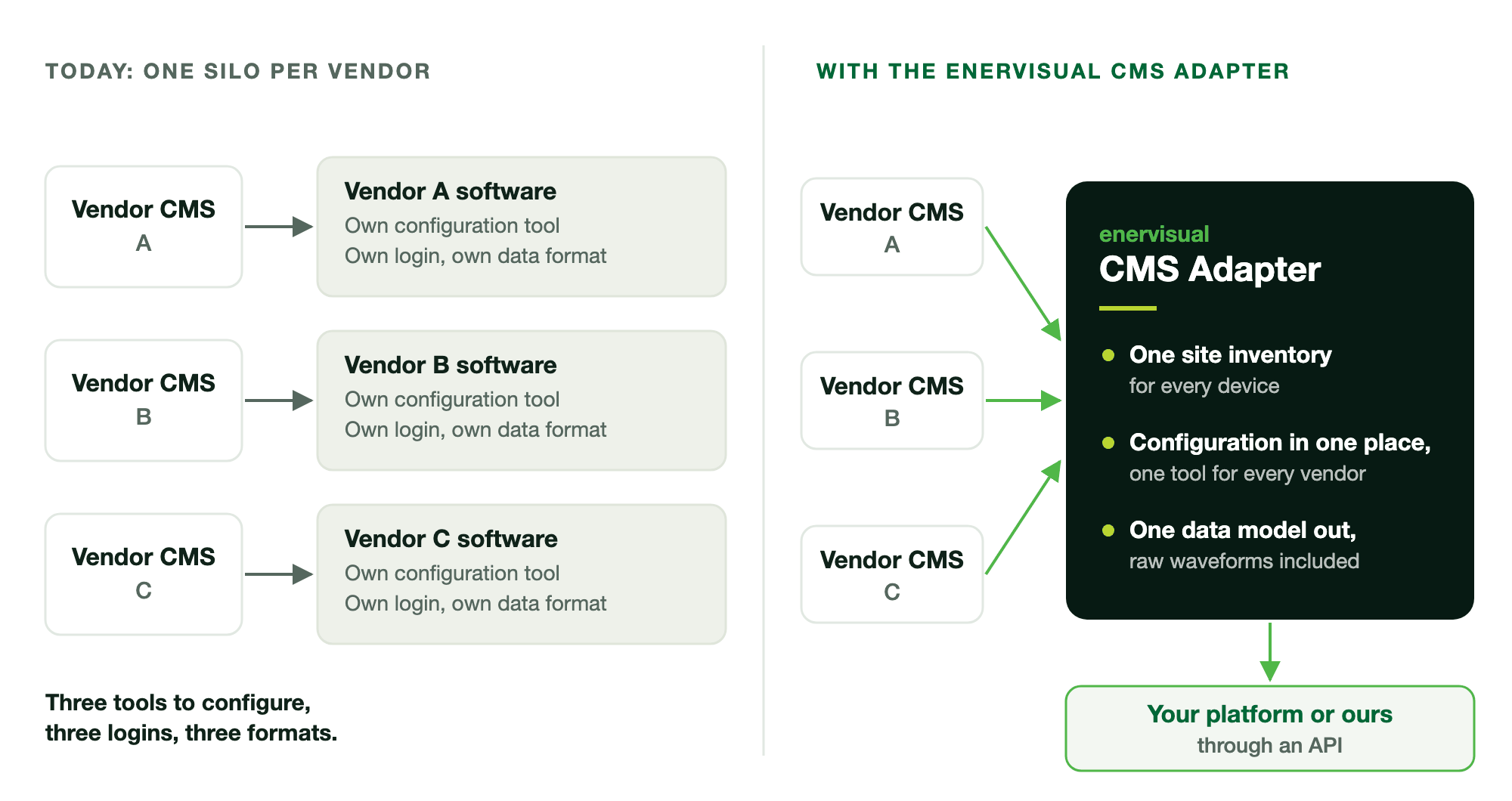
Every vendor CMS comes with its own software, configuration tool, login and data format. A mixed fleet means a specialist, a licence and an integration job per vendor before any analysis can start.
Legacy platforms lose vendor support. And most installed configurations point at the fast end of the drivetrain, while main bearing and planetary failures are the ones that cost the most.
What it does
Reconfigured data capture for main bearings and planetary stages: measurement setups, resolution and spectral bands chosen for the slow end of the drivetrain. Same sensors, new answers.
Time waveforms, spectra and trends from every vendor system in one documented format, with sensor positions, accelerometer specifications, RPM and operating state.
Delivered through an API into the enervisual platform or the system you already use. Your data is not locked into a new vendor either.
Configuration support for CMS platforms the vendor no longer maintains, instead of ripping out working hardware for a forced retrofit.
Software on a site server at the wind farm. No vessel time offshore, no cabling work in the nacelle.
Never touches turbine control. Read-only toward the CMS by default; configuration changes only on your request, with a backup, a read-back check and a log entry.
Who it is for
You maintain turbines from many OEMs, each with its own CMS. Read every system in your portfolio through one interface, see main bearing and planetary condition before you plan the repair, the crane or the vessel, and offer condition-based service without selling new hardware.
Take on a mixed fleet without a retrofit and without an integration project per vendor. Get raw waveforms with full metadata for your analysts and your models, plus the low-speed data the installed configuration never delivered.
Your data in one format that you control, whichever monitoring provider you use, so you stay free to switch. Keep legacy CMS hardware working instead of facing a forced retrofit.
Getting started
The CMS and turbine types in your fleet. We tell you what the adapter can get out of them.
The adapter goes on a site server at one wind farm and reads the existing CMS. Nothing is changed on the turbine.
Add low-speed capture and more sites, based on real data from your own fleet.
FAQ
The major drivetrain vibration CMS platforms found in today's wind fleets, including legacy units the vendor no longer supports. Tell us which CMS your turbines have, and we will tell you what the adapter can get out of it.
It never touches turbine control, and no hardware is installed on the turbine. Toward the CMS it is read-only by default. Configuration changes, such as low-speed capture, are made only when you ask for them, with a backup of the existing setup, a read-back check and a log entry.
Vendor software covers one vendor's hardware and keeps the data in that vendor's format. The adapter puts one interface and one data model in front of every vendor CMS on a site, adds low-speed diagnostics, supports legacy platforms, and delivers to the platform you choose.
Yes. The adapter delivers time waveforms, spectra and trends with full metadata through an API, into our platform or yours.
A drivetrain CMS says nothing about blade bearings, bolt tension or foundations. For those, our battery-powered wireless sensors retrofit without cabling and run alongside the existing CMS.
Tell us the CMS and turbine types in your fleet. We will tell you what the adapter can get out of them.