
Battery-wireless vibration monitoring

Drivetrain & gearbox monitoring

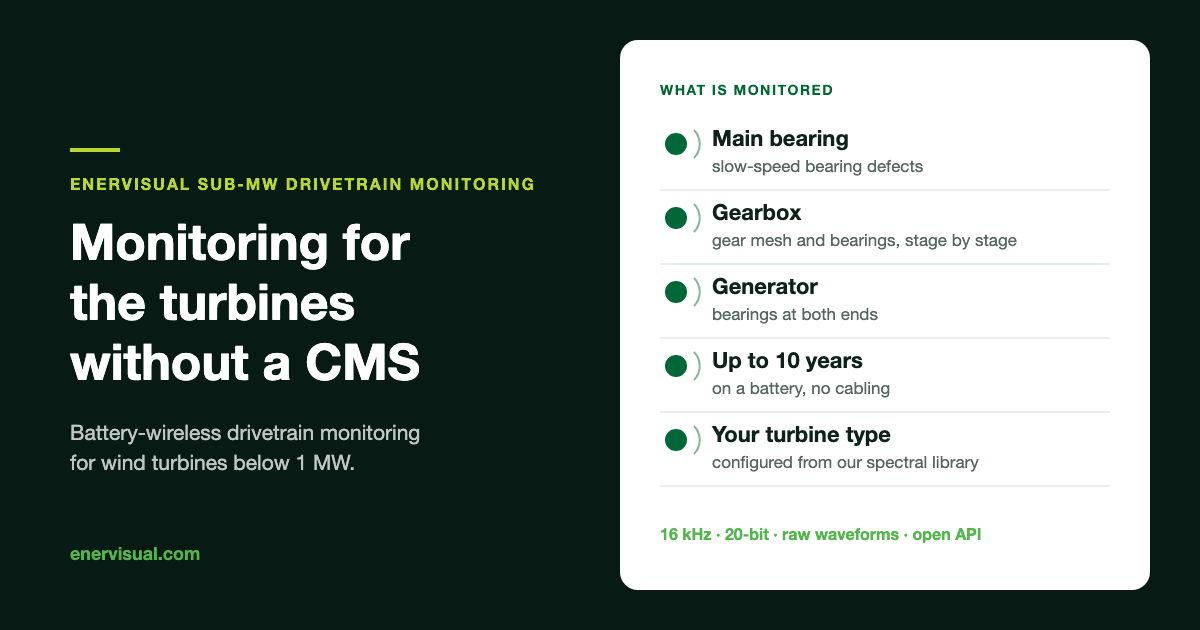
Analyst-grade vibration data from wind turbine gearboxes, bearings and generators, sent wirelessly from a sensor that runs up to 10 years on a battery. Pick your turbine type, and the platform already knows your drivetrain.

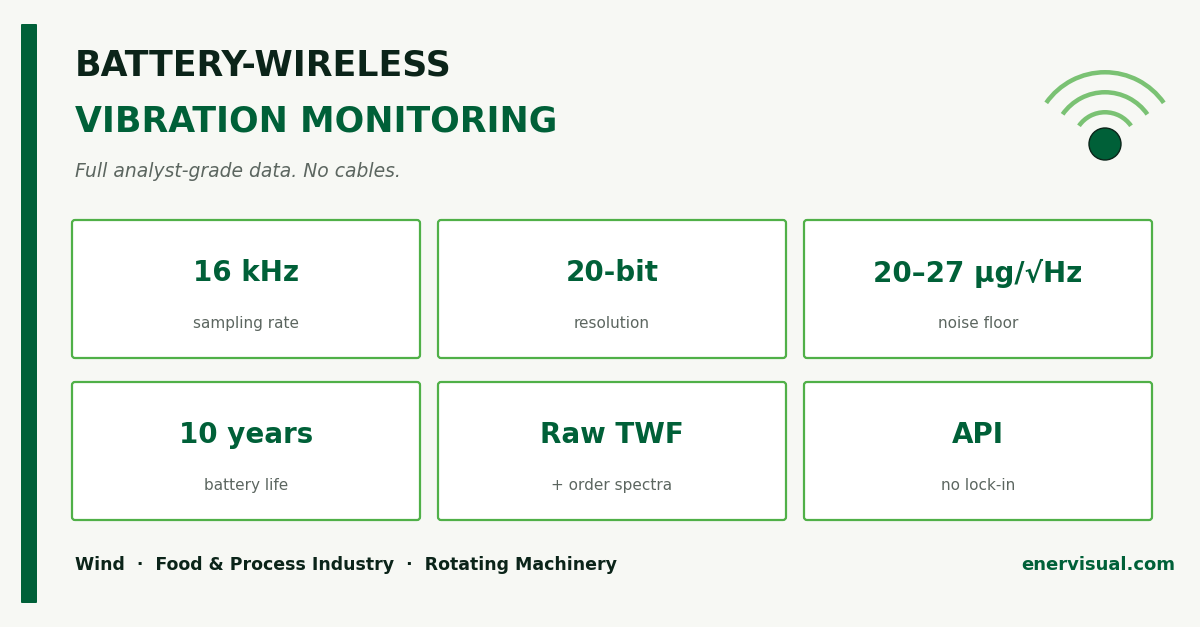
16 kHz
sampling rate
20-bit
resolution
20–27 µg/√Hz
ultralow noise floor
10 yr
battery life, up to
IP67
stud or magnet mount

The problem

Analyst-grade data used to mean a cabling project

Wired systems give analyst-grade data, but they bring cabling, cabinets and mains power, so only the most critical machines get them. Simple wireless sensors are cheap to fit, but they report an overall value: it tells you something changed, not what changed.

And even good data needs a frequency map before it means anything: tooth counts, bearing designations and shaft speeds for your specific gearbox. For a mixed fleet, that setup becomes a project of its own.

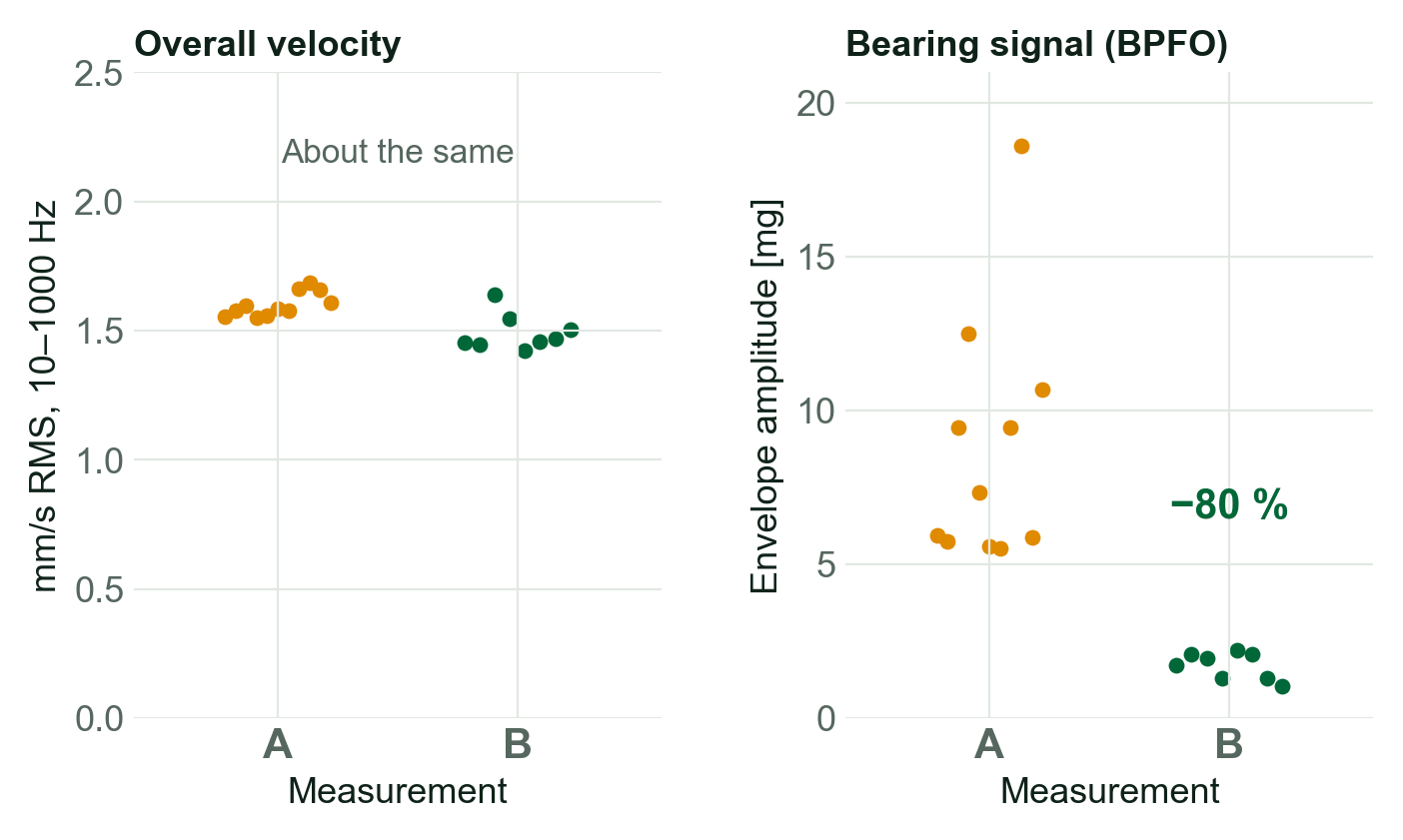
Per-capture comparison of two measurements on the same bearing: the overall vibration velocity is about the same, while the bearing outer-race signal is about 80 % lower in the second measurement.
Real data from one battery-wireless sensor on a 132 kW industrial fan. The overall vibration value is about the same in both measurements, but the raw waveform shows the bearing signal is about 80 % lower in the second. A sensor that only reports an overall value would miss it.

What you get

Built to the standard a vibration analyst expects

01

Raw time waveforms

The actual signal, not just processed indicators: up to 16 kHz sampling, 20-bit resolution and a 20–27 µg/√Hz noise floor. When the platform flags a fault, your analyst (or ours) can open the waveform and confirm it.

02

Order-based analysis

Turbines follow the wind. Normalising spectra to shaft rotation keeps every gear mesh and bearing signature in a fixed place, so fault trends stay comparable at any speed.

03

Your turbine type, pre-configured

A growing library of spectral configurations per turbine type: gear mesh, bearing defect frequencies and shaft orders, checked against real vibration data. A new type is added through our Tooth Count Identification Service.

04

Component-level diagnostics

AI-supported analysis on top of the turbine-specific configuration: not “vibration increased”, but which bearing, which stage, how severe and since when.

05

Up to 10 years on a battery

Measurements are scheduled against operating conditions instead of streaming continuously. That keeps trends comparable, and it is how the battery lasts.

06

The complete chain

Sensor nodes, long-range wireless transmission, web analysis tools and an API that works in both directions. The price you see is the price of a working system.

Who it is for

For turbines with and without a CMS

Turbines without a CMS

Older and smaller turbines often have no drivetrain monitoring at all, and a wired retrofit rarely pays off. Battery-wireless sensors bring analyst-grade monitoring to them without cabling.

Turbines with a CMS

Add measurement points the installed CMS does not cover and bring the data together in one place through the API. To get more out of the installed CMS itself, there is the enervisual CMS Adapter.

Service providers and analysts

Raw waveforms with full metadata for your own analysis, the same validated configuration on every turbine of a type, and new turbines added with a sensor installation instead of an engineering project.

Getting started

Mount the sensor, pick the turbine type

  1. 1

    Mount the sensor

    By stud or magnet on the gearbox, bearing or generator housing. No cabling, no cabinet, no mains power.

  2. 2

    Select the turbine type

    The platform loads the validated spectral configuration for your drivetrain. A type not yet in the library is added through our Tooth Count Identification Service.

  3. 3

    Get diagnoses

    Trends, spectra, waterfalls and waveforms in the browser, component-level alarms, and all data through the API into your own systems.

FAQ

Questions about drivetrain monitoring

Which turbine types are supported?

Our spectral library covers a growing number of wind turbine types, each checked against real vibration data. Tell us your turbine types. If one is not yet in the library, our Tooth Count Identification Service adds it, and the configuration then benefits every operator of that type.

How long does the battery last?

Up to 10 years, depending on how often the sensor measures. Measurements are scheduled against operating conditions rather than streamed continuously, which keeps trends comparable and saves energy.

Do we get the raw data?

Yes. Raw time waveforms can be downloaded and analysed independently, and all data is available through the API. Nothing is hidden inside a proprietary index.

Can it run alongside our existing CMS?

Yes. The sensors are independent of the installed CMS and do not touch it. Use them for points the CMS does not cover, and bring both data sets together through the API. To get more out of the installed CMS itself, see the enervisual CMS Adapter.

Is it only for wind turbines?

No. The same nodes monitor gear motors, pumps, fans and agitators in industrial plants, where cabling is as impractical as it is in a nacelle.

Which turbine types do you run?

Tell us your turbine types and drivetrain. We will tell you whether they are already in our spectral library and what monitoring would look like.