
A gearbox replacement on a 600 kW turbine costs a large share of what it costs on a 2 MW turbine. But the revenue to pay for it is a fraction.
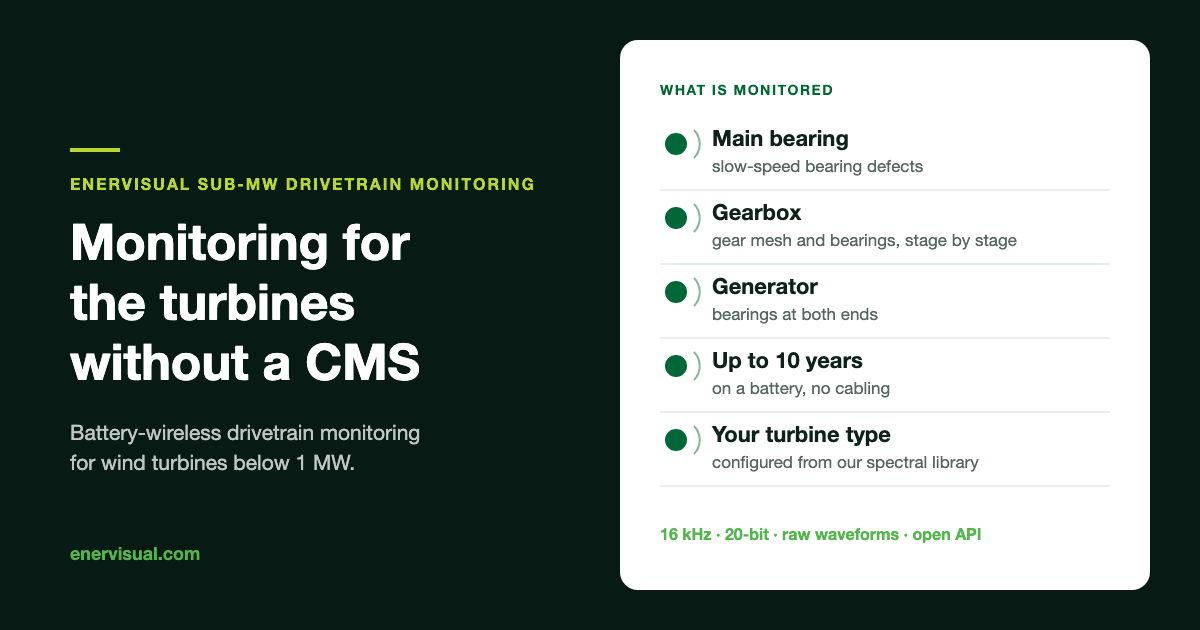
Many wind turbines below 1 MW, built in the 1990s and 2000s, are still producing power. They have a well-understood drivetrain: main bearing, gearbox and generator. And most of them have never had a vibration-based condition monitoring system (CMS). They can now, without a cable, a cabinet or a monitoring project.
Why Sub-MW Turbines Run Without Monitoring
When these turbines were built, drivetrain monitoring was not standard equipment, and the economics of a wired CMS never worked afterwards. Cabling in the nacelle, a measurement cabinet, mains power and an installation project: too expensive per turbine, too complex to install, too hard to justify against the revenue of a small turbine.
So most sub-MW turbines run blind. No vibration trending, no bearing fault detection, no early warning. A developing fault is found when it can be heard, when it shows up in the oil, or when the turbine stops. Then production stops, and the repair bill arrives on the turbine’s schedule, not yours.
Battery-Wireless: Monitoring That Fits the Turbine
Battery-powered wireless sensors remove the cost that kept these turbines unmonitored. Each sensor mounts by stud or magnet on the main bearing, the gearbox or the generator, runs up to 10 years on a battery and sends its data over long-range wireless to a gateway. No cabling, no cabinet, no mains power, and no turbine downtime for the installation.
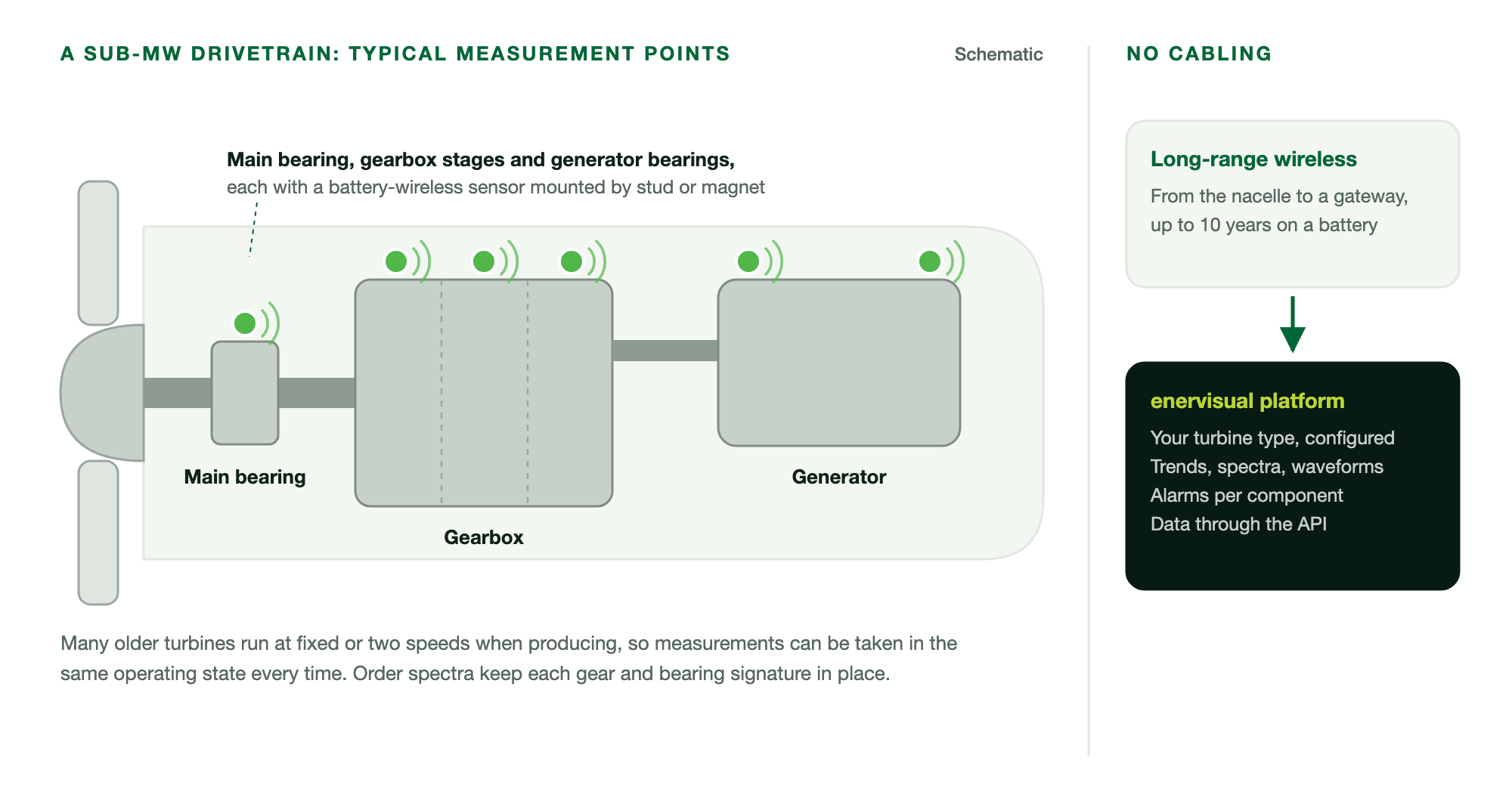
The data quality is the same as on a multi-MW turbine:
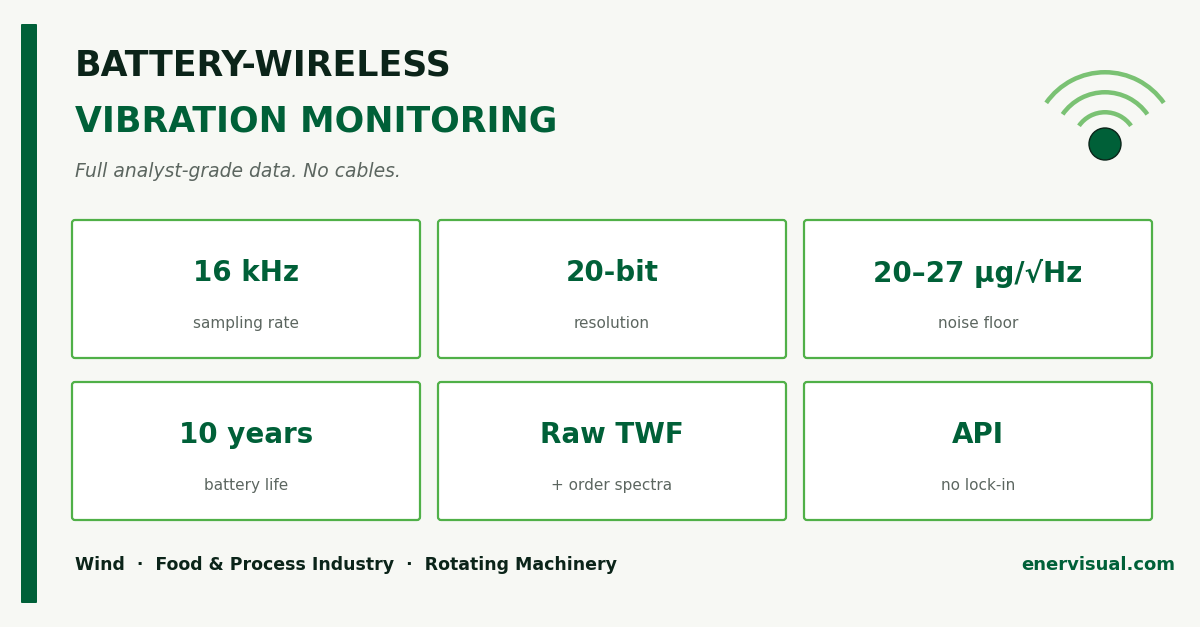
- Sampling up to 16 kHz, for bearing defect frequencies and gear mesh harmonics
- 20-bit resolution and a 20–27 µg/√Hz noise floor, to see a small developing defect next to dominant machine vibration
- Raw time waveforms (TWF), not just processed indicators, available for download and independent analysis
- IP67-rated housings with an industrial temperature range
Built for How Older Turbines Run
Many older turbines run at fixed or two speeds when producing. That makes it straightforward to schedule measurements in the same operating state every time, so trends compare like with like. And because the speed is never perfectly constant, order spectra keep each gear mesh and bearing signature locked in place.
Scheduling measurements against operating conditions, instead of streaming continuously, is also how the battery lasts up to 10 years.
From Emergency to Scheduled Repair
Bearing and gear faults show up in the vibration data long before they stop the turbine, often months ahead. That leaves time to keep the turbine running until the next planned stop, with the parts, the crew and the crane booked in advance.
The turbine keeps producing. The repair costs less. And you decide when it happens.
Your Turbine Type, Configured
A spectrum only becomes a diagnosis when the platform knows which frequencies belong to which component: tooth counts, bearing designations and shaft speeds. Our spectral library holds validated configurations per turbine type. If your type is not in the library yet, our Tooth Count Identification Service adds it, and the configuration then serves every turbine of that type. More in Your Turbine Type. Our Spectral Data. Ready to Go.
What You Get
- Trends and alarms per component: main bearing, gearbox stages and generator bearings
- Spectra, waterfall plots and raw waveforms in any browser
- AI-supported diagnosis at component level: which bearing, which stage, how severe and since when
- All data through the API, into your own maintenance systems
Who This Is For
Owners of single turbines and small wind farms who want warning before a gearbox fails, without a monitoring project.
Service companies maintaining older fleets, who can plan repairs, cranes and spare parts from trends instead of breakdowns, across turbines of different makes.
Owners planning lifetime extension, who need evidence that the drivetrain can run for more years.
The Short Version
- Drivetrain monitoring for wind turbines below 1 MW, which mostly never had a CMS
- Battery-wireless sensors on main bearing, gearbox and generator, mounted by stud or magnet, up to 10 years on a battery
- Analyst-grade data: up to 16 kHz, 20-bit, raw waveforms, order spectra
- Your turbine type configured from our spectral library, or added by the Tooth Count Identification Service
- No cabling, no cabinet, no turbine downtime for installation
- Faults found early, often months ahead: an emergency becomes a scheduled repair
Features, use cases and FAQ: enervisual drivetrain and gearbox monitoring.
Tell us your turbine type, and we will tell you whether it is already in our spectral library and what monitoring would look like.