
Your turbines have condition monitoring installed. The question is whether it still works for you — or for the vendor who stopped supporting it.
Most wind turbines above 1.5 MW left the factory with a vibration-based condition monitoring system (CMS) on the drivetrain. SKF, Brüel & Kjær Vibro, Bently Nevada, Gram & Juhl TCM, Gamesa SMP — the hardware is there, the sensors are mounted, the acquisition units have been running for years.
And yet we keep meeting operators who cannot get what they need out of it. Not because the hardware failed. Because of two problems nobody mentions in the sales brochure.
Problem 1: The Vendor Has Moved On
CMS platforms have lifecycles, and the vendors’ attention follows the new generation. For operators running earlier-generation systems, the pattern is familiar:
Configuration changes need the vendor — and the vendor no longer offers them for that platform. Firmware updates stop. The engineering team that knew the product has moved to the successor product. Eventually the official answer becomes: upgrade to our new system, or migrate to our current platform.
The Gamesa SMP is the clearest example. Thousands of turbines still run SMP-8C and SMP-12C units — solid, GL-certified hardware doing its job — while the official path forward is a full retrofit to a different CMS. The installed system works; the support around it has evaporated.
For the operator, this means a monitoring system frozen in its original configuration, measuring what somebody decided it should measure fifteen years ago.
Problem 2: That Original Configuration Points the Wrong Way
Most installed CMS configurations were set up for the fast end of the drivetrain — high-speed shaft, generator bearings. That’s where classical vibration analysis works best, so that’s where the measurement setup, spectral bands and alarm thresholds point.
But a main bearing turns at 10–20 rpm. Planetary stages barely faster. Defect energy at those speeds sits at frequencies the standard configuration was never set up to resolve — so a developing main bearing or planet bearing fault runs quietly below every alarm threshold, right up until it doesn’t.
And these are precisely the failures that cost the most: main bearing and planetary exchanges mean big cranes, long lead times, and — offshore — jack-up vessels.
Here is the part most operators don’t know: this is usually a configuration problem, not a hardware problem. The accelerometers on the drivetrain can capture the low-speed data. The acquisition unit can be set up to resolve it. What’s missing is the ability to change the configuration — which brings us back to Problem 1.
The CMS Adapter
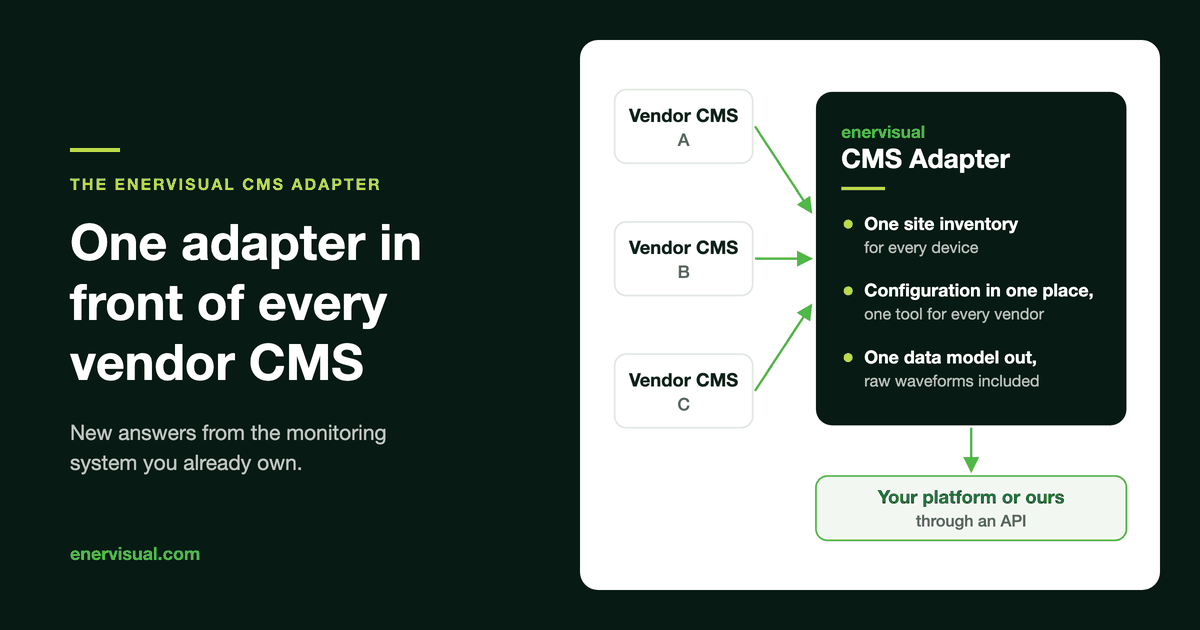
The enervisual CMS adapter is software that runs on a site server at the wind farm and connects to the vibration monitoring system already installed. It never touches turbine control. Toward the CMS it is read-only by default: configuration changes are made only when you ask for them, with a backup of the existing setup, a read-back check and a log entry.
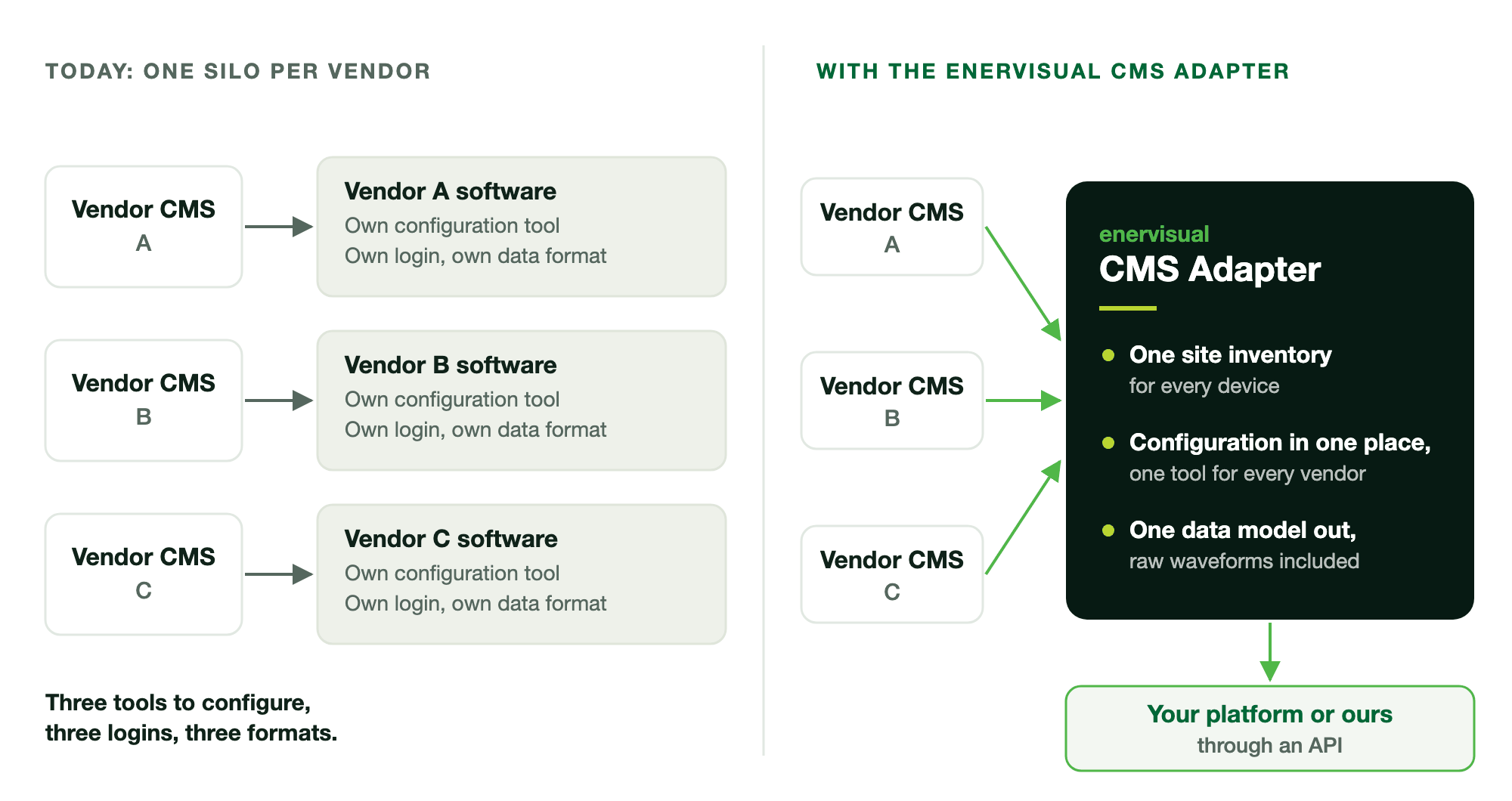
What it does:
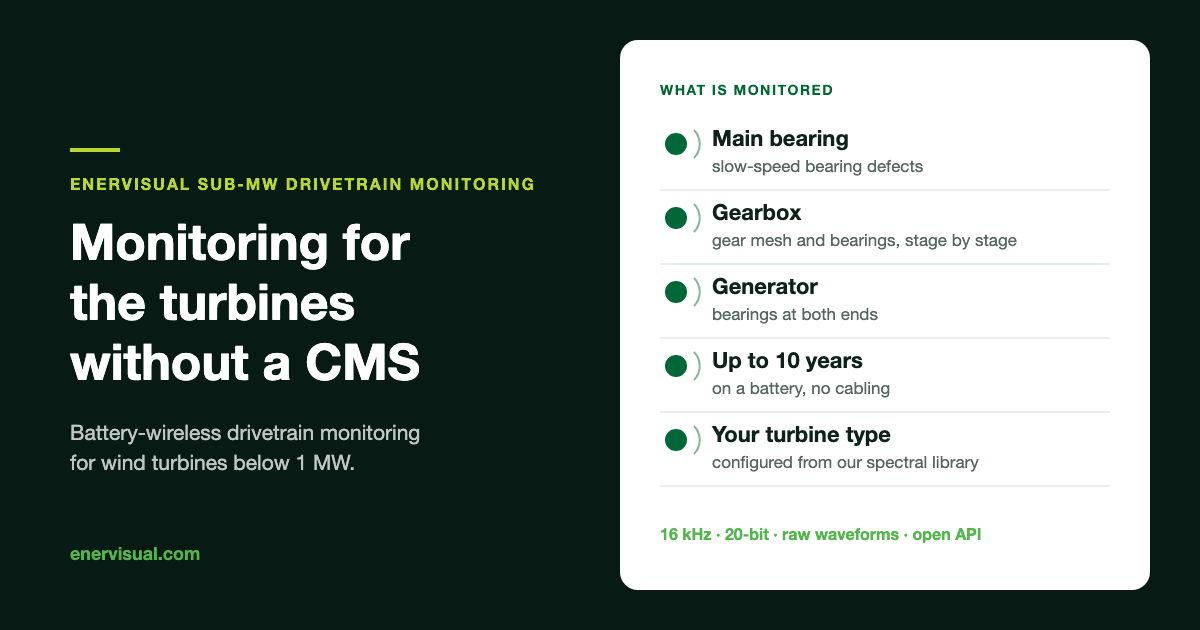
Reconfigures data capture for what you actually need. Low-speed diagnostics on main bearings and planetary stages is the most common request: new measurement setups, resolution and spectral bands chosen for the slow end of the drivetrain. Same sensors, same turbine — new answers.
Unlocks the data into one open format. The adapter reads from the installed system and delivers time waveforms, spectra and trends in a documented open format, with the metadata that makes the data usable: sensor positions, accelerometer specifications, RPM and operating state. Delivery is through an API, into our platform or yours. Your data stops being locked to the vendor’s software.
Keeps legacy systems alive. For platforms the vendor no longer maintains, we provide the configuration support that keeps the installed hardware doing its job. The alternative on offer is ripping out working hardware and buying a new CMS. Keeping what works and upgrading what it delivers costs a fraction of that.
For offshore fleets, one property matters above all: no new hardware on the turbine. No vessel time for sensor installation, no cabling work in the nacelle. The adapter works with what is already out there.
Which Systems?
The adapter works with the major drivetrain CMS platforms found in today’s fleets, including legacy units the vendor no longer supports. Tell us what is installed in your turbines, and we will tell you what the adapter can get out of it.
Getting started is simple: one site, read-only, nothing changed on the turbine.
For Independent Service Providers
You maintain turbines from many OEMs, and every one of them comes with its own CMS. When you take over from the OEM service contract, the monitoring often stays behind: the system is still in the nacelle, but you can’t read it.
With the adapter you can:
- Read every vendor CMS in your portfolio through one interface
- See main bearing and planetary condition before you plan the repair, the crane or the vessel
- Offer your customers condition-based service without selling them new hardware
Monitoring providers taking on a mixed fleet get the same: one interface, one data format.
And for What the Installed Sensors Can’t See
A drivetrain CMS watches the drivetrain. It says nothing about blade bearings, bolt tension, or the structure beneath the tower.
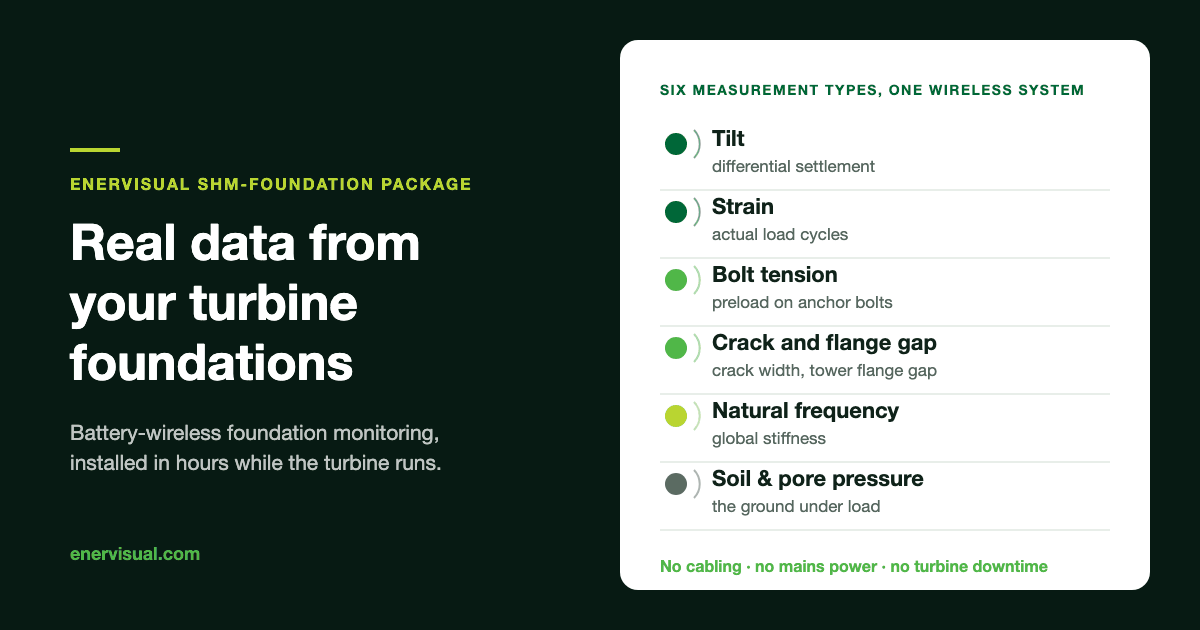
Where those answers are needed, our battery-powered wireless sensors retrofit without cabling: blade bearing crack detection, blade root insert and bolt tension monitoring, and structural monitoring of jackets, gravity base foundations and onshore foundations. Installed in hours on an operating turbine, running alongside the existing CMS without touching it.
The combination covers the whole machine: the adapter upgrades what the installed system delivers, the wireless sensors add what it never measured.
Who This Is For
Operators of legacy CMS fleets — above all Gamesa SMP fleets — who want their installed, working hardware to keep delivering instead of facing a forced retrofit.
Offshore operators where every hardware change carries vessel costs, and where the most expensive failure modes — main bearing, planetary stage — are exactly the ones the standard configuration resolves worst.
Owners with mixed fleets who want one data format and one analysis platform across turbines carrying five different vendors’ monitoring systems.
Independent service and monitoring providers who need high-resolution data with full metadata out of every vendor system in their portfolio, as described above.
The Short Version
- Software on a site server, connecting to the CMS already installed — never touches turbine control; read-only by default, configuration changes only on your request
- Reconfigured data capture for low-speed diagnostics: main bearing, planetary and low-speed gear stages
- One open data format with full metadata, delivered through an API
- Configuration support for legacy platforms the vendor abandoned
- Works with the major drivetrain CMS platforms, including legacy units the vendor no longer supports
- No new hardware on the turbine — which matters a great deal offshore
If your fleet’s most expensive components are the least monitored ones, the fix may not be a new monitoring system. It may be getting the one you own to finally deliver.
Features, use cases and FAQ: the enervisual CMS Adapter.
Contact the enervisual team to discuss your fleet’s CMS setup.