Battery-wireless SHM

Wind turbine structural health monitoring (SHM)

Engineering data from blades, tower and foundation: vibration, inclination, strain, proximity, humidity and temperature, from battery-wireless sensors that are time-synchronised across the structure. Compact, quick to install and with no large start-up cost, so SHM is within reach of every operation and maintenance business.

3
structures: blades, tower, foundation
5
SHM sensor types
Synchronised
sensors across the structure
Low CapEx
no cabling, no large start-up cost

The problem

Decisions about structures need data from the structure

Lifetime extension, repowering, erosion around offshore foundations and ageing foundation soil all come down to the same question: how does the structure actually behave? Design calculations and visual inspections describe the turbine as it was planned, not as it is today.

Conventional SHM systems answer it, but they need cabinets, mains power and cabling, and multiplied across a wind farm the business case collapses. enervisual SHM sensors are compact, battery-powered and wireless, so engineering-grade structural data becomes practical across a fleet.

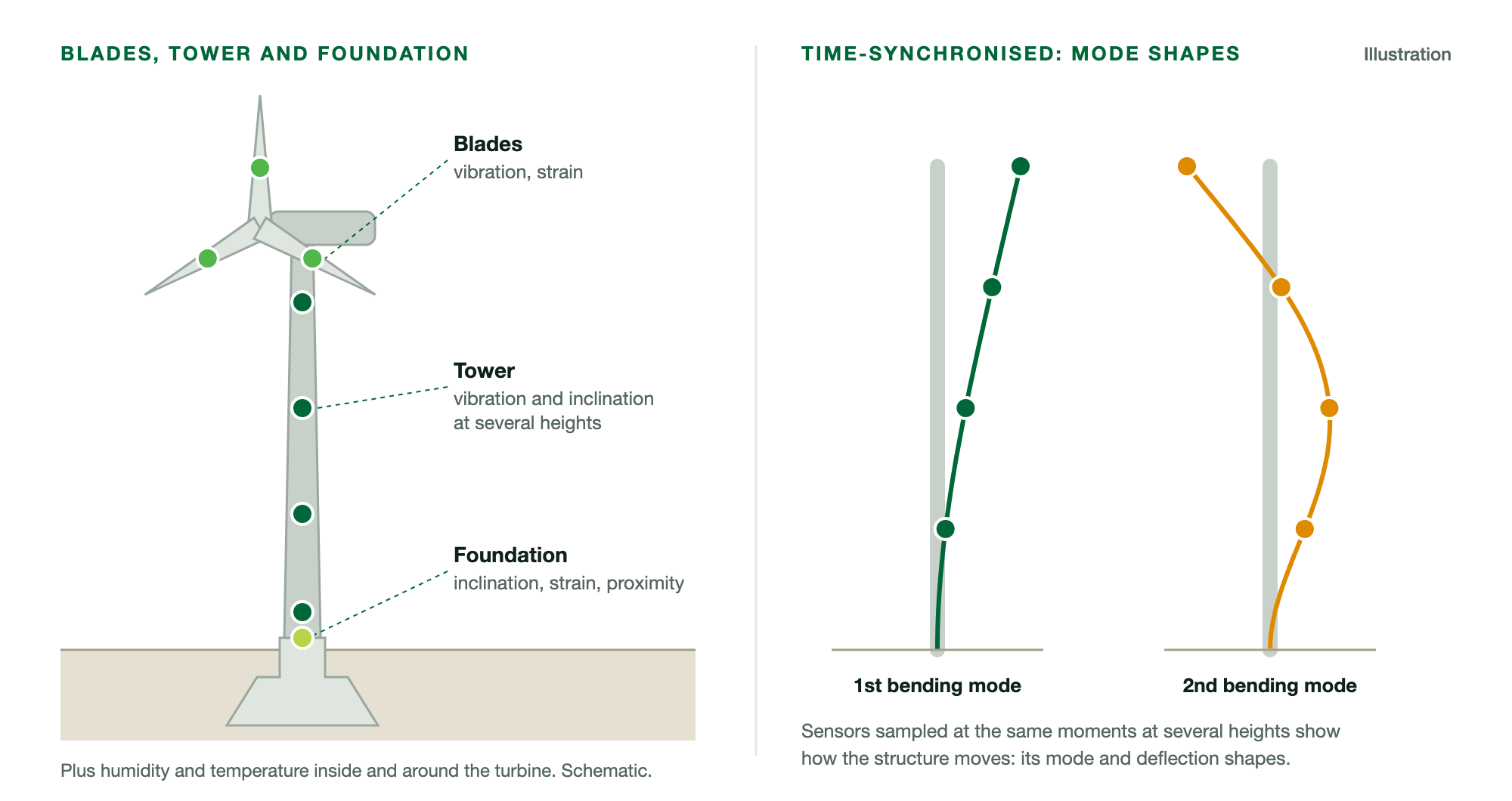
Left: a wind turbine with battery-wireless SHM sensors on the blades (vibration, strain), at several heights on the tower (vibration and inclination) and at the foundation (inclination, strain, proximity). Right: an illustration of the first and second bending mode shapes of a tower, drawn through time-synchronised sensors at four heights.
Left: where SHM sensors go on blades, tower and foundation (schematic). Right: time-synchronised sensors at several heights show the mode and deflection shapes of the tower (illustration).

What you get

The physical behaviour of the structure, in engineering terms

01

Time-synchronised sensors

All SHM sensors are time-synchronised, so data from blades, tower and foundation can be compared in the analysis. That is what makes it possible to determine mode and deflection shapes of the structure.

02

SHM-Vibration

Vibration of tower and blades: natural frequencies and how they change, the structural signature of the turbine.

03

SHM-Inclination

Tilt of tower and foundation, in two axes. Together with strain, it gives the input for the engineering calculation of the foundation stiffness.

04

SHM-Strain

Strain gauges capture the actual load cycles in the structure, the basis for fatigue assessment from measured data.

05

SHM-Prox

Proximity sensors measure distance and gaps on the structure.

06

Configurable, open data

Sample rate, time waveform length and upload interval are configurable. Access, view and analyse the data on the web platform or through the open API, with easy integration into your systems.

What the data is for

Verify the decisions you are facing

Lifetime extension

Show how the structure behaves after decades of operation, with measured data instead of conservative assumptions.

Repowering

Know the condition of tower and foundation before deciding whether they can carry a new turbine.

Offshore erosion and ageing soil

Erosion around offshore foundations and ageing foundation soil change how the structure behaves. Measured over time, the change becomes visible.

Getting started

From the question to synchronised data

  1. 1

    Tell us the question

    Turbine type, the structures of interest and the decision the data must support.

  2. 2

    Install the sensors

    Compact, battery-powered and wireless sensors on blades, tower and foundation, with no cabling. Sample rate, waveform length and upload interval set for your analysis.

  3. 3

    Analyse the data

    Time-synchronised data on the web platform, or through the open API in your own analysis and systems.

FAQ

Questions about structural health monitoring

Which sensors are in the SHM package?

SHM-Vibration, SHM-Inclination, SHM-Strain, SHM-Prox and Humidity-Temperature, for blades, tower and foundation. Other sensors measure the environment inside and around the turbine.

Why does time synchronisation matter?

Because the sensors sample at the same moments, data from different places on the structure can be compared directly. That allows mode and deflection shapes of the structure to be determined.

Can we choose the measurement settings?

Yes. Sample rate, time waveform length and upload interval are among the configuration options included.

Is the wireless technology proven?

Yes. The battery-powered wireless technology is certified worldwide and well proven and understood, so there are no surprises.

Can it detect specific blade and foundation defects?

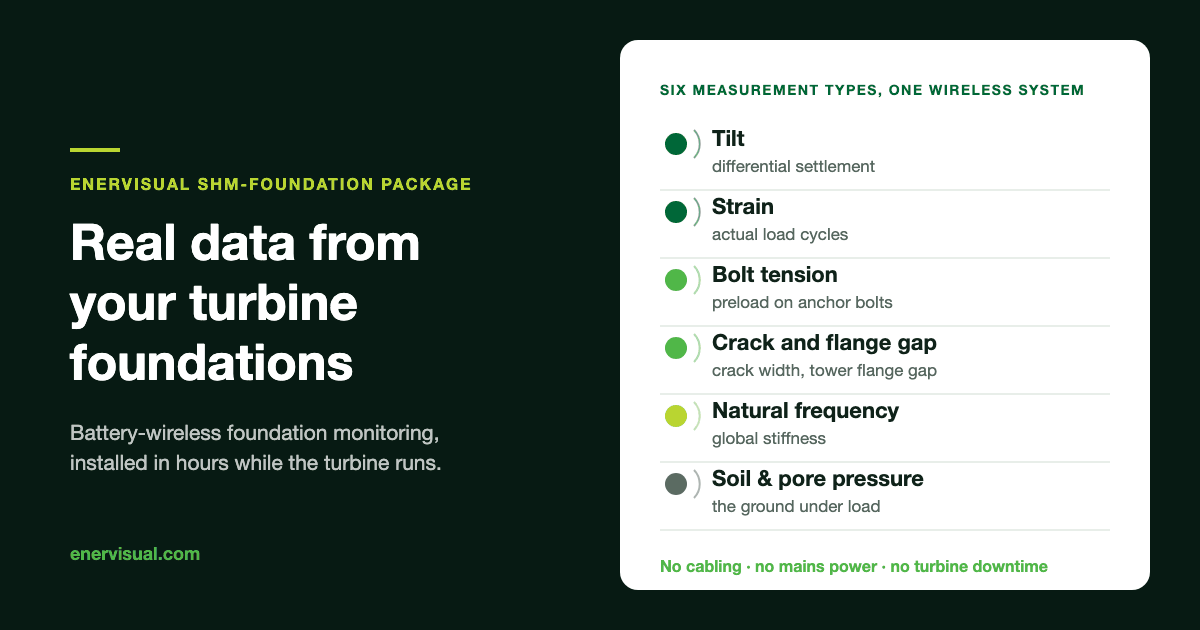
Yes. Dedicated setups cover blade root insert gap detection, blade bearing race cracks and blade structural cracks, and the SHM-Foundation Package covers the foundation, including its rotational stiffness.

Can it run alongside our existing CMS?

Yes. The sensors add what the condition monitoring system does not cover, and the data can be interfaced to the existing CMS so everything is in one place.

Which structure would you like to understand?

Tell us the turbine, the structure and the decision ahead. We will suggest the sensors and how to set them up.