

enerVib · battery-powered · three axes

Wireless vibration sensor

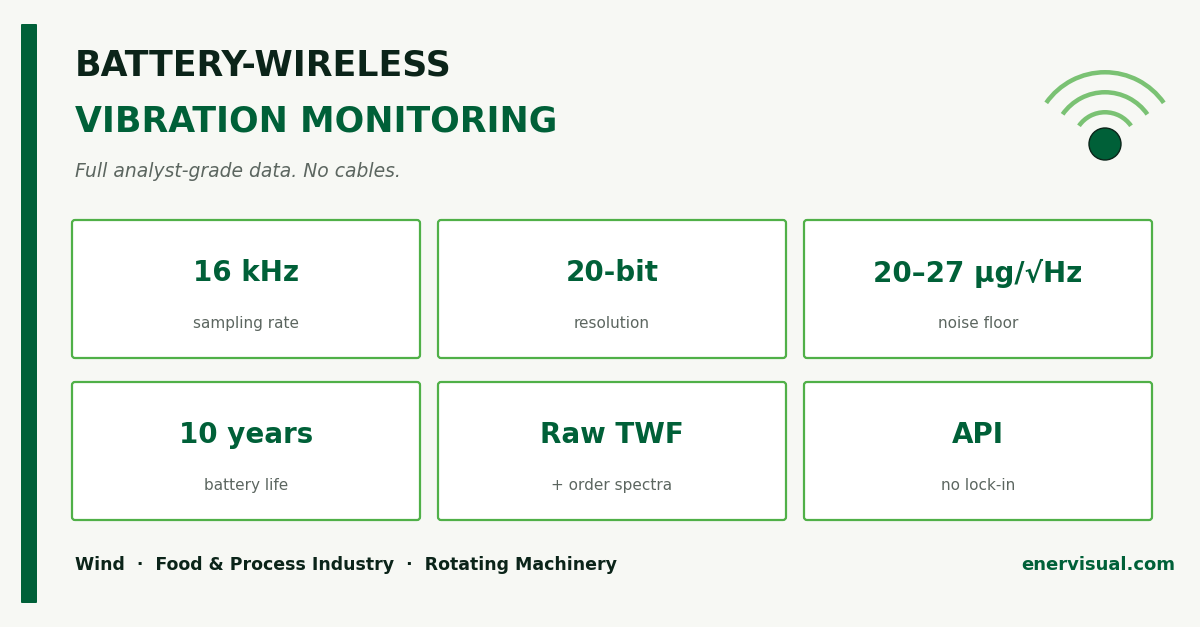
enerVib is a battery-powered wireless vibration sensor that measures on three axes and sends the raw time waveform, not only an overall value. It mounts in minutes on wind turbines and industrial machines and runs up to 10 years on a battery.

3 axes
X, Y and Z
16 kHz
sampling rate, up to
20–27 µg/√Hz
ultralow noise floor
10 years
battery life, up to
IP67
stud or magnet mount

Why the sensor matters

Most wireless vibration sensors report one number

A simple wireless vibration sensor reports an overall value, such as RMS velocity. That tells you something changed, not what changed. Many also sample too slowly and resolve too coarsely to show an early bearing or gear fault.

enerVib was built for the opposite job. It captures the raw waveform with the sampling rate, resolution and noise floor a vibration analyst expects, so a finding can be traced to a component and checked in the signal itself.

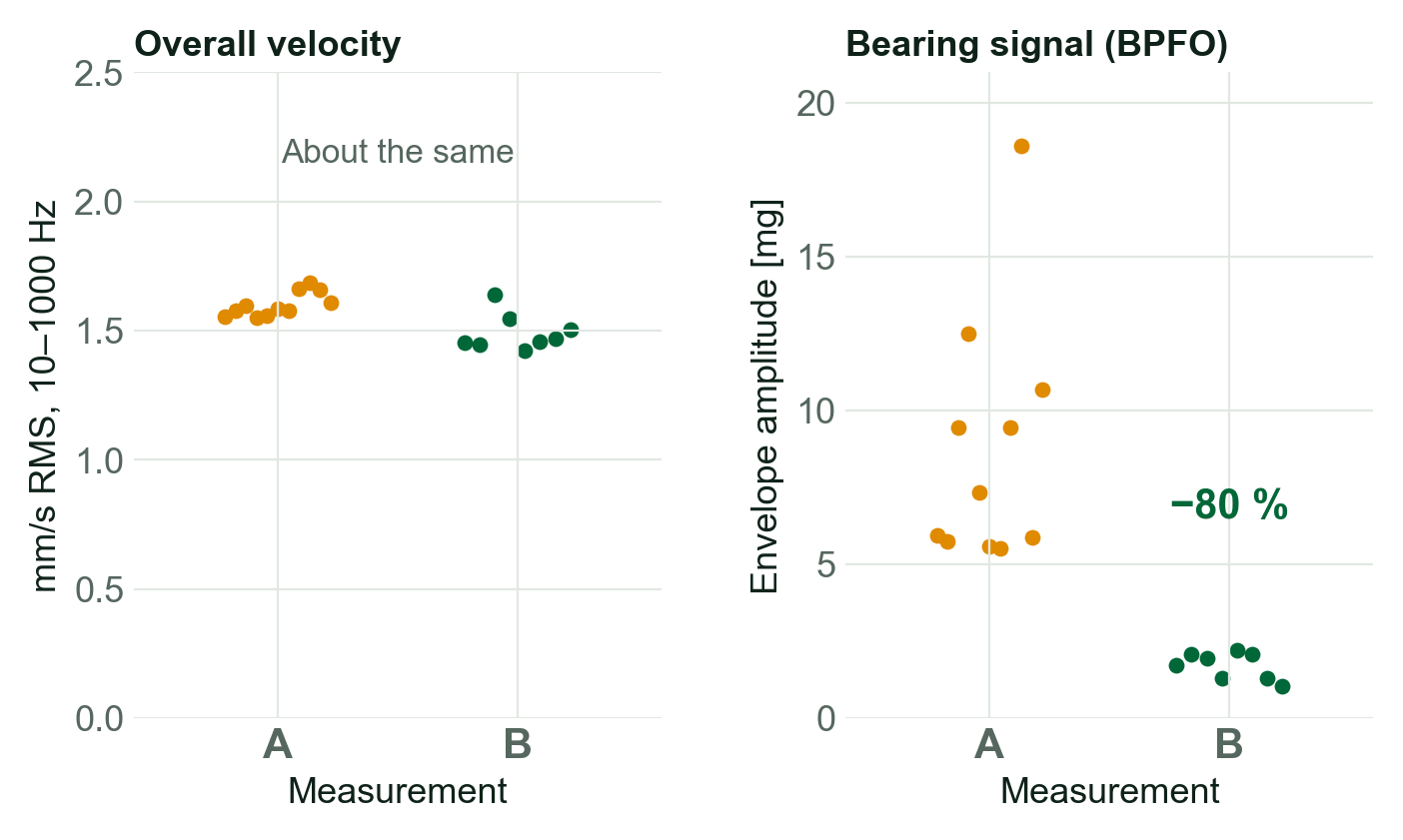
Two measurements, A and B, on the same fan bearing. Left: the overall vibration velocity is about the same in both, around 1.5 mm/s RMS. Right: the envelope amplitude at the bearing outer-race defect frequency (BPFO) is about 80 % lower in B.
Real data from one enerVib sensor on a 132 kW industrial fan. Each dot is one capture. The overall velocity, the single number a simple wireless sensor reports, is about the same in measurements A and B, while the bearing signal is about 80 % lower in B.

The sensor

What the enerVib wireless vibration sensor delivers

01

Three axes, low noise

Vibration in X, Y and Z from one sensor, with 20-bit resolution and a noise floor of 20–27 µg/√Hz. Early faults produce very small amplitudes, and the sensor has to see them next to the dominant machine vibration.

02

Raw waveforms and scalar values

Sampling up to 16 kHz. Each measurement includes the raw time waveform (TWF) as well as scalar values for trending, and the waveform can be downloaded for independent analysis.

03

Up to 10 years on a battery

The sensor does not stream continuously. It measures when the machine is in a defined operating state, which keeps trends comparable and is how the battery lasts.

04

Long-range wireless

Low-power transmission from sensor to gateway to cloud, for remote wind turbines and factory floors alike. No signal cable, no cabinet and no mains power at the machine.

05

Mounts in minutes

IP67-rated housing with an industrial temperature range, mounted by M8 stud or magnet. No machine downtime for installation. A high-temperature version is available for hot locations.

06

Settings for each sensor

Sample rate, capture length and measurement schedule are settings for each sensor, so every machine gets the measurement that suits it.

The complete system

A sensor that comes with everything behind it

A vibration sensor on its own monitors nothing. The data has to travel, land somewhere and become an answer. enerVib is delivered with the whole chain: wireless transmission, a web platform and an API.

In the browser you get trends, spectra, order spectra for variable-speed machines, waterfall plots, waveform download and alarms, with no software to install and no per-seat licences.

Through the API the same data goes into your maintenance platform, historian, dashboards or your own analytics. Your data stays yours.

Where it is used

One sensor for wind turbines and industrial machines

Wind turbine drivetrains

Gearboxes and drivetrains in the nacelle, with pre-configured spectral libraries for specific wind turbine types: you select the turbine type and the platform knows which frequencies belong to which component.

Drivetrain and gearbox monitoring →

Industrial machinery

Gear motors, pumps, fans and blowers, agitators, motors and generators in production, food and process plants, energy production and mining.

Industrial vibration monitoring →

Analysts and monitoring providers

Raw waveforms for your own analysis and your own models, by download or through the API. Nothing is hidden inside a proprietary index.

Getting started

From box to first measurement

  1. 1

    Mount the sensor

    By M8 stud or magnet on the bearing housing, gearbox or motor. No cabling and no downtime.

  2. 2

    Select the machine

    Pick the wind turbine type from the library, or describe the machine: speed, bearings and gears.

  3. 3

    Read the data

    Trends, spectra and waveforms in the browser, alarms per component, and all data through the API.

FAQ

Questions about the wireless vibration sensor

What does the enerVib wireless vibration sensor measure?

Vibration on three axes (X, Y and Z), sampled at up to 16 kHz with 20-bit resolution and a noise floor of 20–27 µg/√Hz. It delivers scalar values for trending and the raw time waveform, from which the platform builds spectra, order spectra and envelope spectra.

How is it different from other wireless vibration sensors?

Many wireless vibration sensors report an overall value only. enerVib sends the raw waveform, so a fault can be traced to a specific bearing or gear and confirmed by an analyst in the signal itself.

How long does the battery last?

Up to 10 years, depending on how often the sensor measures. It does not stream continuously. It measures when the machine is in a defined operating state, which keeps trends comparable and saves energy.

How does the data get from the sensor to us?

By long-range, low-power wireless from the sensor to a gateway on site and on to the cloud. You read it in the web platform in any browser, or receive it in your own systems through the API.

How is the sensor mounted?

By M8 stud or magnet, in minutes. The housing is IP67-rated. No cabling, cabinet, mains power or machine downtime is needed.

Can it measure on hot machines?

Yes. A high-temperature version of the sensor is available for hot locations.

Does it work on variable-speed machines?

Yes. Besides conventional spectra, the platform delivers order-normalised spectra, so bearing and gear signatures stay in place and trends are comparable at any speed.

Do we get the raw data?

Yes. Raw waveforms can be downloaded and analysed independently, and all data is available through the API.

Where is the sensor made?

In the European Union. enervisual is a Danish company, and the sensors are designed and manufactured in the EU.

Which machines would you like to measure on?

Tell us the machines or turbine types and the site. We will tell you how the sensor fits and what the data would look like.