
The package for detection of Blade Root Insert Gap from enervisual is a direct and accurate method. Sensors designed to measure the gap between blade root and blade bearing. The most critical consequence is where a wind turbine blade will detach from the blade bearing and hub. This can be avoided by this measurement.
Both old and new turbines have these blade specific defects.
Today identifying the Blade Root Gap defect is a manual and time consuming job. It can be up to a day of work for a maintenance team. The process can be like this:
- Travel to the wind turbine location
- Stop wind turbine and lock rotor
- Move to the hub and look for gap between blade and blade bearing
- Leave the hub, unlock rotor
- Turn rotor, lock and repeat the process
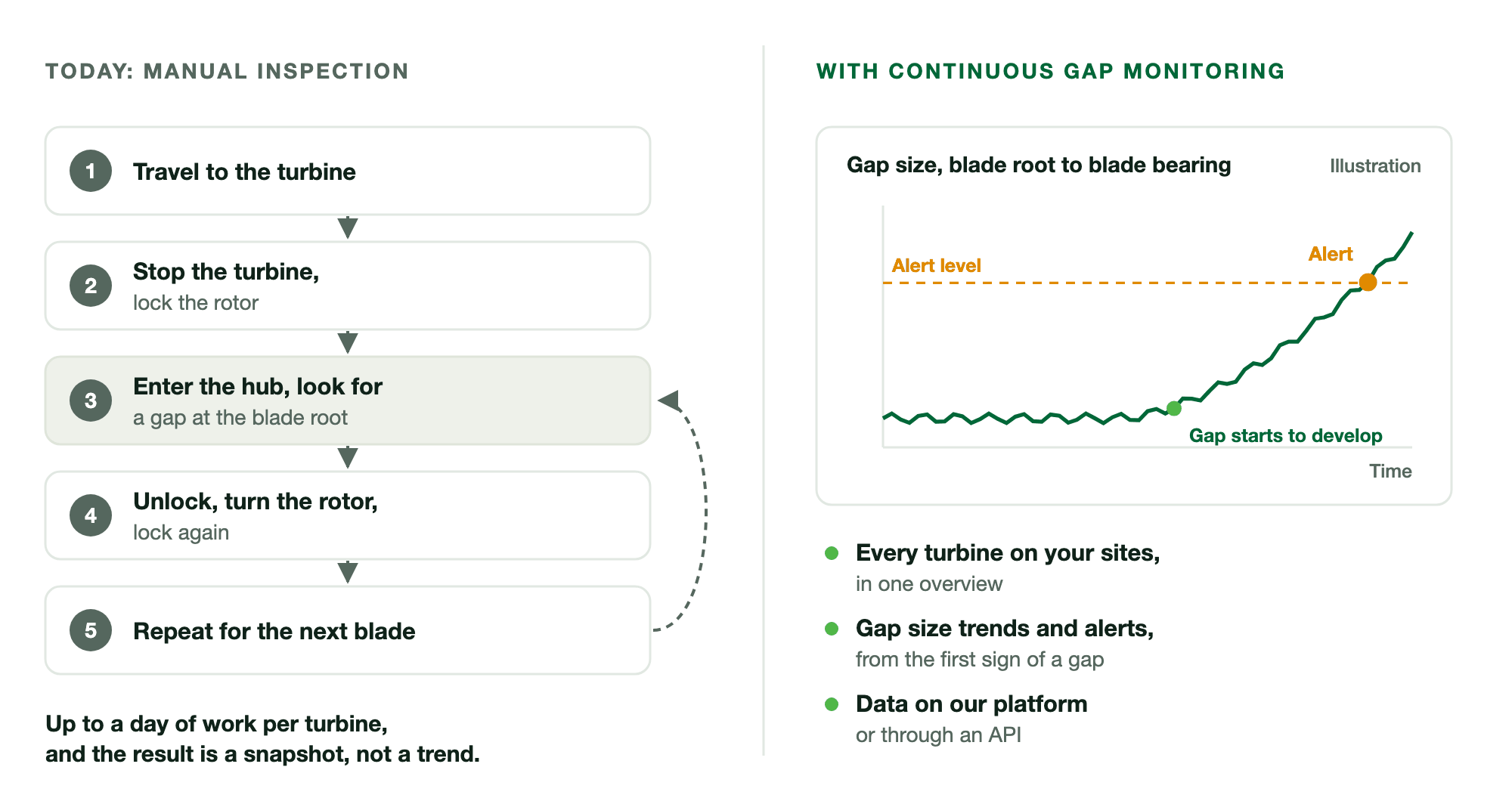
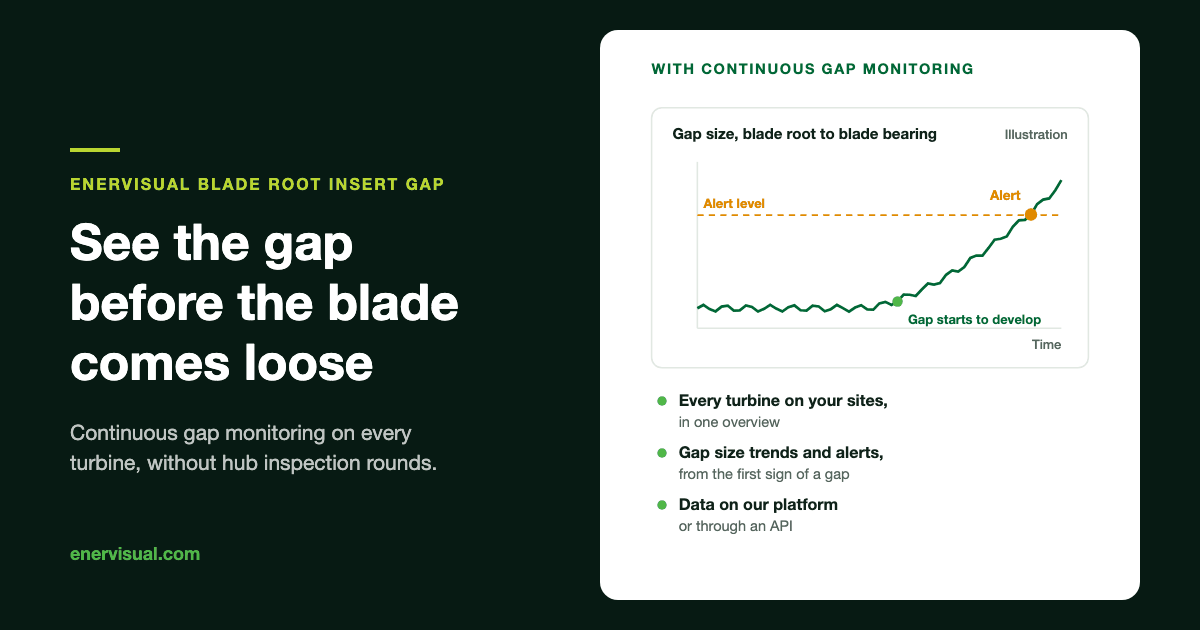
The Blade Root Insert Gap Package will ease the routine inspections as you get a full overview of all the turbines at your sites. Data can be integrated as needed from the enervisual data web API.
Detecting the initial phase of a gap development is crucial to avoid serious damage. Not just the blade detaches from the hub but also the safety risk and risk of damage if the blade hits the tower.
With the Blade Root Insert Gap Package operators know the wind turbines are safe for production. Though the defect is in early phase the Blade Root Insert Gap Package tracks any developing gap and alerts.
- Long Battery Life
- Trends of the gap size
- Alerts on gap size
- Data hosted or available from API
- Integration with monitoring systems
The gap is measured in millimetres, on each blade on its own. As the rotor turns, the weight of the blade loads the root in tension and compression: a sound root joint stays closed at 0 mm, while a developing defect makes the joint open and close once per revolution. In one example, a blade with a gap of just 0.6 mm stood out clearly. And because every blade is measured separately, you know exactly which blade has the gap before the team travels to the site.
Features, use cases and FAQ: enervisual Blade Root Insert Gap monitoring.
The installation cost of this unique package is making new standards for what is possible with retrofits for wind turbines.
Contact the enervisual experts and get more knowledge and information.