From measurement challenge to monitoring solution — how enervisual makes foundation data practical.
In our previous post, we examined why wind turbine foundations are fundamentally different from conventional structures. Overturning moments 40 times higher than ground-mounted rotating equipment. Settlement limits three times stricter than building codes. Bolted connections that silently lose preload over millions of load cycles. And a repowering wave that demands answers about foundations designed 15-20 years ago.
The conclusion was clear: design calculations and periodic visual inspections are not enough. You need real, continuous data from the structure itself.
This post shows how the enervisual SHM-Foundation Package delivers exactly that.
The Practical Barrier: Why Foundations Went Unmonitored
If continuous foundation monitoring is so valuable, why do most wind turbines operate without it?
The answer is practical, not technical. Traditional structural health monitoring systems were built for bridges, dams, and high-rise buildings — projects where a dedicated measurement cabinet, mains power, cable trays, and a site engineer are part of the budget.
A wind turbine foundation is different. It sits in a field, often far from the nearest technician. The turbine above it is owned by an operator watching every euro of OPEX. Running cables through a foundation that was cast twenty years ago is invasive and expensive. And multiplying a conventional SHM installation across a 50-turbine wind farm makes the business case collapse before it starts.
The result: foundations became the least monitored safety-critical component in the entire turbine.
This is the barrier the SHM-Foundation Package removes.
One Package, Every Critical Parameter
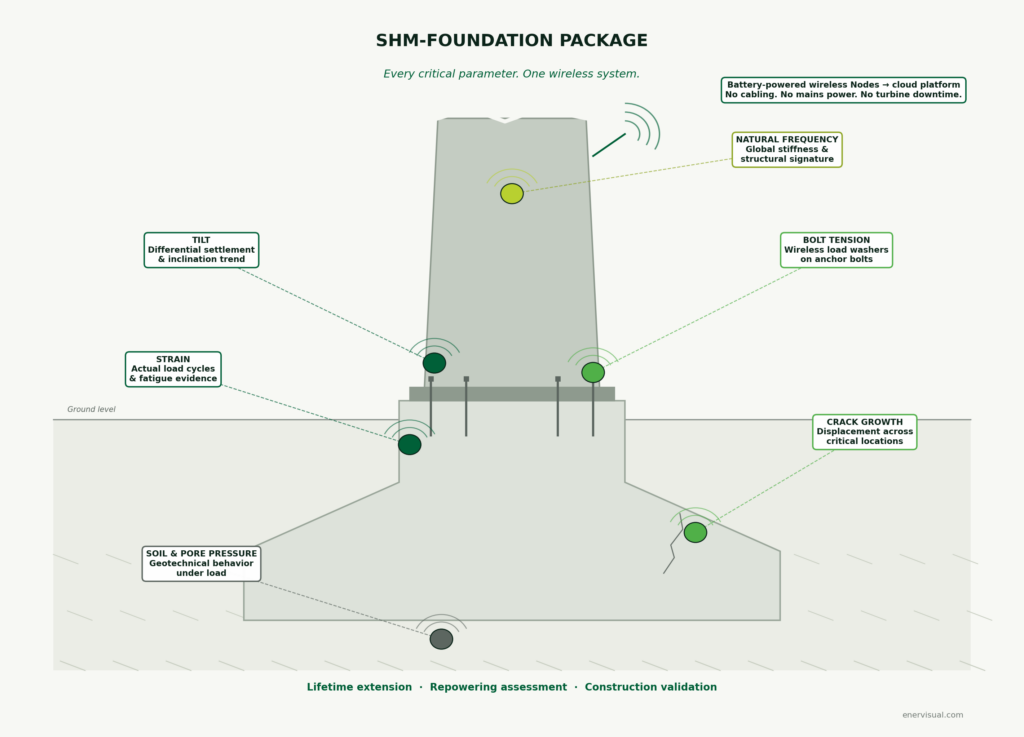
The SHM-Foundation Package is built on the enervisual Node platform — battery-powered, wireless measurement nodes that install on existing structures without cabling, without mains power, and without turbine downtime.
Each Node connects to the sensor types that foundation assessment guidelines call for:
Tilt (Inclination) Continuous measurement of foundation and tower inclination — the direct indicator of differential settlement. Where a periodic survey gives you a snapshot every few years, continuous tilt data reveals trends, seasonal variations from freeze-thaw and groundwater changes, and any acceleration that demands attention. Resolution is sufficient to track changes well below the 1 mm/m differential settlement limit that governs turbine operation.
Strain Strain gauges on the foundation and tower base capture the actual load cycles the structure experiences. This is the data that transforms fatigue assessment from assumption to evidence: instead of estimating remaining fatigue life from design load spectra, you calculate it from measured stress history.
Bolt Tension Wireless load washers measure actual clamping force on tower-foundation bolts — continuously. As we described in the previous post, bolt preload relaxation is often the limiting factor in foundation life. Continuous tension measurement catches preload loss long before gap formation begins, converting a future emergency repair into a scheduled maintenance task.
Concrete Crack Growth Displacement sensors track crack width development at critical locations. A stable crack is a documented condition; a growing crack is an early warning. The difference between the two is only visible with continuous measurement.
Natural Frequency The foundation-tower system has a structural signature: its natural frequencies. Changes in stiffness — from soil consolidation, concrete degradation, or connection loosening — shift these frequencies in measurable ways. Tracking natural frequency over time provides a global health indicator for the entire structural system, complementing the local measurements above.
Soil and Pore Pressure For sites where geotechnical behavior is a concern — piled-raft foundations in clay, sites with fluctuating groundwater — soil pressure and pore pressure sensors document how the ground beneath the foundation actually behaves under load.
All sensor data flows wirelessly from the Nodes to the enervisual cloud platform, where it is trended, correlated with turbine operating data, and monitored against configurable alarm thresholds.
Installation: Hours, Not Weeks
A conventional SHM installation is a construction project. The SHM-Foundation Package is a service visit.
Nodes mount on the existing structure — no core drilling for cable routes, no cabinet installation, no coordination with the turbine’s electrical system. A typical foundation installation is completed in hours, and the turbine keeps running throughout.
Battery life is measured in years, not months. There are no site visits for data collection: measurements arrive in the cloud platform automatically, and the system alerts you when something changes.
This is what makes fleet-wide deployment economically realistic. The cost and complexity that made conventional SHM impractical for wind farms simply do not apply.
Three Use Cases Where the Data Pays for Itself
1. Lifetime Extension
Across Europe, thousands of turbines are approaching or exceeding their 20-year design life. Lifetime extension frameworks — such as the German BWE guidelines — require operators to demonstrate that continued operation is safe. These frameworks explicitly recognize crack monitoring, inclination monitoring, and accompanying condition monitoring as valid assessment methods, and they favor permanent measurement over periodic campaigns.
The SHM-Foundation Package provides precisely this evidence base. Instead of arguing from conservative assumptions, the operator presents measured data: actual settlement history, actual crack stability, actual bolt tension, actual load cycles. That evidence supports longer extension periods and fewer restrictive conditions.
2. Repowering Assessment
Can a foundation designed for a 1.5 MW turbine carry a 3 MW replacement? As we discussed in the previous post, this question cannot be answered from design drawings alone. It requires knowing the foundation’s current condition: how much it has settled, whether the connection is intact, how much fatigue capacity remains.
A monitoring period before the repowering decision — even 12 months — delivers the measured baseline that turns a conservative guess into an engineering assessment. For foundations that pass, this unlocks reuse and saves the cost of a new foundation. For foundations that don’t, it prevents an expensive mistake.
3. Construction Validation and New-Build Optimization
For new wind farms, monitoring the first turbines during construction and early operation validates the foundation design against reality. If measured settlements come in below predictions, there may be room to optimize the design for the remaining turbines. If they don’t, you know before the problem multiplies across the site.
Measurement-validated design is also the path to less conservative — and less expensive — next-generation foundations. Three-dimensional foundation models are only as good as their validation data. The SHM-Foundation Package provides it.
From Reactive to Predictive — For the Structure, Too
The wind industry has spent two decades learning that drivetrain condition monitoring pays for itself: catch the bearing fault early, plan the repair, avoid the unplanned stop.
The same logic applies below the tower flange. Foundation problems discovered visually are discovered late — when repair costs are highest and operational restrictions are most severe. Foundation problems detected in trend data are caught early, while the full range of responses is still available.
The SHM-Foundation Package brings foundations into the same predictive maintenance philosophy that already governs the drivetrain. Continuous data. Early warning. Repairs on your schedule.
Getting Started
Every foundation monitoring project starts with a conversation about the structure: foundation type, age, known concerns, and what decisions the data needs to support. From there, we configure the sensor package, plan the installation, and have data flowing within weeks.
Whether you are building the evidence base for lifetime extension, evaluating a repowering project, validating a new design, or simply replacing uncertainty with data — the starting point is the same.
Real data from your foundations. Delivered wirelessly, continuously, and economically.
Contact the enervisual team to discuss your fleet.
Learn more about enervisual’s battery-wireless monitoring solutions at enervisual.com
0 Comments